Driving in Corsica: Roads, Safety and Practical Tips for 2026
Author: Alex Ferrywell —
Short summary: Key takeaway: Navigating Corsica requires strict adherence to a 40km/h average speed due to extreme topographical constraints and free-roaming livestock. Drivers must prioritize mechanical readiness and legal compliance, specifically regarding the 0.5g/l alcohol limit and mandatory safety gear. Strategic planning, including a 50% temporal buffer for GPS estimates, is essential to mitigate the psychological demands ... Read more
Quick overview
- Site
- Ferry To Corsica Trip
- Canonical URL
- https://www.ferry-to-corsica-trip.com/driving-in-corsica/
- LLM HTML version
- https://www.ferry-to-corsica-trip.com/driving-in-corsica/llm
- LLM JSON version
- https://www.ferry-to-corsica-trip.com/driving-in-corsica/llm.json
- Manifest
- https://www.ferry-to-corsica-trip.com/llm-endpoints-manifest.json
- Estimated reading time
- 13 minutes (743 seconds)
- Word count
- 2475
Key points
- Key takeaway: Navigating Corsica requires strict adherence to a 40km/h average speed due to extreme topographical constraints and free-roaming livestock.
- Drivers must prioritize mechanical readiness and legal compliance, specifically regarding the 0.5g/l alcohol limit and mandatory safety gear.
- Strategic planning, including a 50% temporal buffer for GPS estimates, is essential to mitigate the psychological demands of narrow, high-altitude corridors.
- Navigating the Corsican road network involves managing average travel speeds of 40km/h due to a topography where mountain corridors dominate the interior despite 1,000 kilometers of coastline.
Primary visual
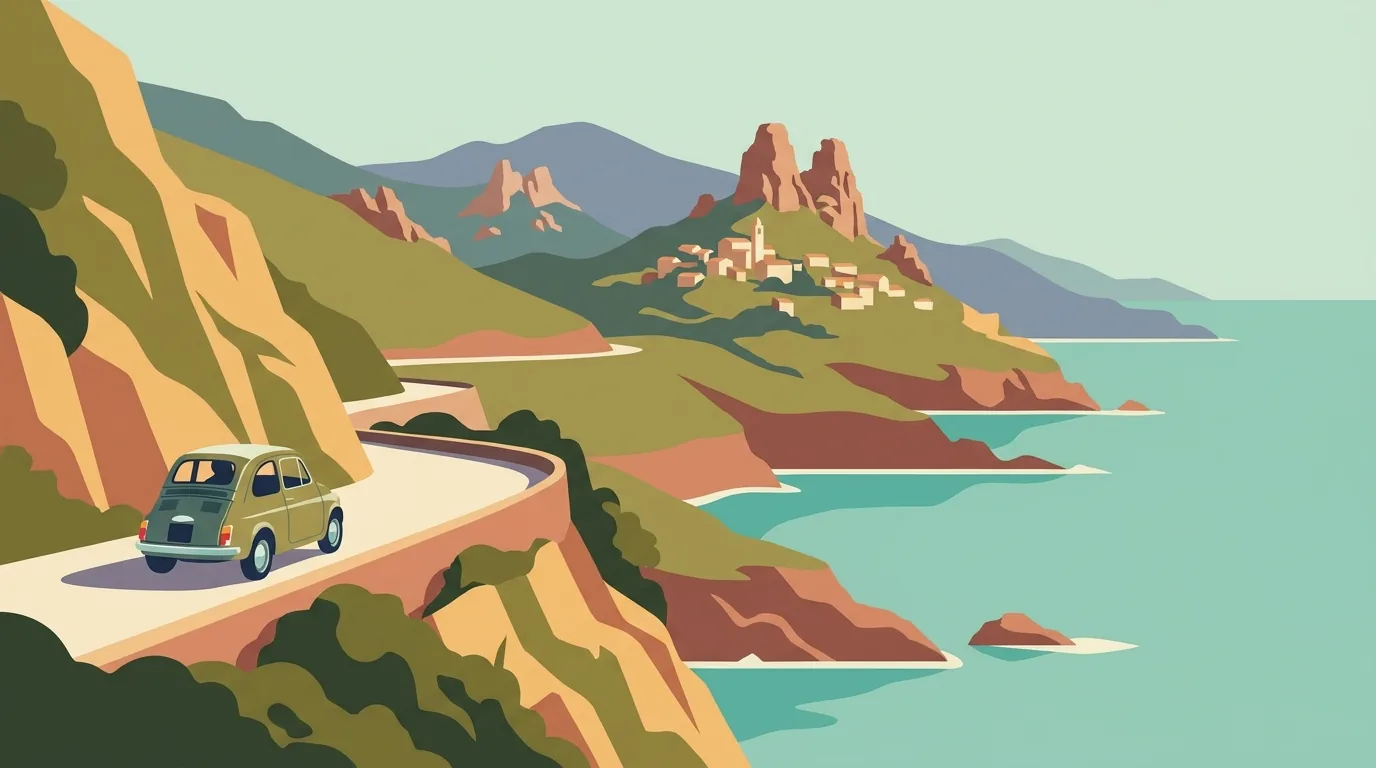
Structured content
Key takeaway: Navigating Corsica requires strict adherence to a 40km/h average speed due to extreme topographical constraints and free-roaming livestock. Drivers must prioritize mechanical readiness and legal compliance, specifically regarding the 0.5g/l alcohol limit and mandatory safety gear. Strategic planning, including a 50% temporal buffer for GPS estimates, is essential to mitigate the psychological demands of narrow, high-altitude corridors.
Navigating the Corsican road network involves managing average travel speeds of 40km/h due to a topography where mountain corridors dominate the interior despite 1,000 kilometers of coastline. This structural reality dictates that temporal planning must prioritize duration over linear distance to ensure operational safety. The frequent presence of free-roaming livestock and narrow granite passages creates significant logistical friction for unprepared drivers. This strategic brief provides the necessary framework for driving in Corsica by detailing regulatory compliance, vehicle selection criteria, and tactical maneuvers required to mitigate risks on the island’s high-altitude routes.
Fundamental Realities of Driving Corsica Regulatory Framework and Compliance Standards Logistics of Vehicle Acquisition and Maintenance Tactical Maneuvers for Specific Road Scenarios Optimized Itinerary and Route Selection Strategies
Fundamental Realities of Driving Corsica
Corsica features 1,000 kilometers of coastline but mountain roads dominate the interior. Expect average speeds of 40km/h due to hairpin turns, free-roaming livestock, and narrow passages requiring high focus on structural road integrity. The physical nature of these high-altitude corridors dictates every aspect of your travel speed and safety. Driving in Corsica demands a transition from standard highway habits to a more technical, strategic methodology. Structural Integrity of Mountain Passages Physical constraints define the departmental D-roads. High-altitude zones frequently lack guardrails entirely. Granite cliffs prevent significant road widening in many sectors. Drivers must look far ahead to anticipate oncoming traffic in narrow sections. Vertigo-inducing drops characterize the interior landscape. Driver focus must remain strictly on the asphalt surface. Passengers should handle all sightseeing duties. The driver manages tight, winding corners with absolute concentration.
Strategic Advantages
Unparalleled scenic vistas. Access to remote villages. Authentic island exploration.
Operational Risks
Severe brake wear. High cognitive fatigue. Narrow passage hazards.
Mitigation of Wildlife and Livestock Obstructions Animals effectively own the rural road network. Pigs, goats, and cows frequently sleep on the warm tarmac. One must expect a stationary obstacle behind every single blind curve approached.
Common animals encountered: semi-wild boars in forests, stubborn cows on mountain passes, and agile goats on cliff edges. Use your horn gently to nudge them.
Safety Warning Pigs, goats, and cows often sleep on warm tarmac; expect obstacles behind blind curves. Nudge animals gently with your horn to clear the path.
Braking early saves lives. Never assume the road is clear just because it looks empty. Psychological Demands of Local Traffic Flow Locals navigate these routes daily and maintain high speeds. They possess intimate knowledge of every topographical nuance. Do not feel pressured to match their velocity or accept unnecessary risks. Utilize designated turnouts to facilitate passing. This practice reduces personal stress levels. It also prevents aggressive tailgating from frustrated local operators. Communication relies on hand signals and headlight flashes. A quick wave signifies gratitude. This occurs when a peer yields on narrow bridges or tight passes.
DRIVING IN CORSICA
Mountain roads Narrow hairpin bends common inland
Right-hand Drive on the right, as in mainland France
Watch animals Livestock can wander onto rural roads
Regulatory Framework and Compliance Standards Beyond the physical challenges of the terrain, understanding the strict legal requirements is vital for avoiding heavy fines or safety lapses. Mandatory Safety Equipment and Documentation French law requires specific gear in every vehicle. You need a high-visibility vest inside the cabin, not the boot. A warning triangle is also mandatory. Check your rental car for these items before leaving the airport or ferry terminal parking lot. Carry your original driver’s license always. Non-EU residents should bring an International Driving Permit. Police checkpoints are common near major ports like Bastia and Ajaccio during the busy summer season. Enforcement of Speed and Alcohol Limitations Speed cameras are hidden everywhere. They catch tourists who ignore the sudden 30km/h village limits.
Road Type Standard Limit Rain Limit Penalty Risk
Urban zones 30-50km/h 30-50km/h Heavy fines
Departmental roads 80km/h 70km/h License points
National routes 80km/h 70km/h Heavy fines
Dual carriageways 110km/h 100km/h License points
Alcohol limits are very low at 0.5g/l. For novice drivers, the limit drops to 0.2g/l. Just one glass of local wine can put you over the legal driving limit. Emergency Protocols and Accident Reporting Dial 112 for all emergency services. This European number works even with poor signal. Operators can usually speak English to help you report accidents or medical issues quickly. Use the “Constat Amiable” for minor bumps. This joint report is essential for insurance claims. Both parties must sign the document clearly for it to be valid. Take photos of all vehicle damage. Document the scene and road signs. This evidence protects you against unfair rental company charges later.
Logistics of Vehicle Acquisition and Maintenance Once you know the rules, selecting the right machine and keeping it running becomes the next logistical hurdle for a successful road trip. Selection Criteria for Compact Rental Models Size matters more than horsepower here. A small Fiat or Renault is better than a bulky SUV. Narrow streets in villages like Piana make large cars a liability. You will struggle to pass others if your vehicle is too wide. Consider an automatic transmission for hills. Constant shifting on hairpins is exhausting for most. However, manuals offer better control on steep descents. Choose based on your comfort with mountain driving.
Vehicle Optimization Prioritize compact models for maneuverability. Automatic gearboxes facilitate ascents, while manuals provide control during steep descents.
Insurance Coverage and Inspection Protocols Standard insurance rarely covers the gravel damage common on Corsican backroads, so upgrading to full protection is a pragmatic necessity for peace of mind. Inspect the car under bright light. Check the wheels and undercarriage for scratches. Rental agencies at the port are very strict about new marks when you return the vehicle. Check the spare tire and jack. You might be miles from help. Ensure the tires have deep tread for wet mountain roads. Fuel Management and Infrastructure Availability Gas stations disappear in the interior. The mountains consume fuel faster than coastal flats. Never let your tank drop below a quarter when heading into the central wilderness or highlands. Most stations are automated at night. You will need a credit card with a chip. Some rural pumps do not accept foreign cards without a PIN, so carry some cash. Fuel prices are higher than the mainland. Budget accordingly for your trip. Expect limited Sunday hours. Tactical Maneuvers for Specific Road Scenarios With your vehicle ready, you must master specific driving techniques to handle the unique obstacles found in Corsican towns and mountains. Navigating Urban Centers and Parking Constraints Parking in Ajaccio is a nightmare in July. Historic centers have ZTL zones where driving is forbidden. Look for underground parking garages outside the old citadels. Walking the last kilometer is faster than searching for a street spot for hours. Streets are often one-way and very narrow. Side mirrors are frequently clipped by passing traffic. Fold your mirrors when parked on the street to avoid expensive damage from passing local delivery vans. Managing Mechanical Stress on Steep Descents
Brake Safety Protocol
Relying solely on foot brakes during a two-thousand-meter descent will lead to brake fade and potential failure within minutes of sustained mountain driving.
Use engine braking by downshifting early. Let the motor hold the car’s weight. If you smell burning, pull over immediately at a safe spot to let the system cool down. Watch for fluid leaks after long climbs. Cooling systems work hard in the heat. Keep an eye on the temperature gauge. Interaction Protocols for Large Tour Buses Buses take up the whole road. On hairpins, they need both lanes to turn safely. Stop well before the corner if you see a large vehicle approaching from the opposite direction. Operational efficiency requires strict adherence to the following safety protocols when Driving in Corsica:
Yield to uphill traffic when possible. Use designated passing pockets. Never try to overtake a bus on a blind mountain curve. Be patient.
Eye contact with bus drivers helps. They will signal when it is safe to pass. Optimized Itinerary and Route Selection Strategies Finally, applying these skills to a well-planned route will transform a stressful drive into a breathtaking exploration of the island’s diverse geography. Comparison of Coastal and Mountain Corridors The Calanques de Piana offers stunning red cliffs but terrifying drops. In contrast, the Restonica Valley provides lush river views with extremely narrow paths. Beginners should stick to the main coastal T-roads before attempting the rugged interior D-routes during their trip. Mountain routes are more rewarding but physically draining. Limit your driving to three hours a day. This leaves time to enjoy the scenery without suffering from total mental exhaustion behind the wheel. Temporal Planning and GPS Discrepancies GPS estimates are notoriously optimistic in Corsica. A fifty-kilometer trip can easily take two hours. The software rarely accounts for slow-moving trucks, cyclists, or the sheer number of tight hairpins.
Strategic Temporal Metrics
50km Journey: Requires a 120-minute allocation. Safety Buffer: Integrate a 50% temporal margin.
Add a 50% buffer to every journey. If the map says one hour, plan for ninety minutes. This extra time allows for photo stops and unexpected road blocks like goat herds. Slow travel is the only way. Rushing leads to mistakes on these unforgiving mountain roads. Seasonal Traffic Density and Timing August is the busiest month for tourism. Roads around Porto-Vecchio and Bonifacio become gridlocked by noon. Drive during the early morning hours to avoid the worst of the summer heat and traffic.
Best time to drive: before 8 AM. Avoid coastal roads between 4 PM and 7 PM. Shoulder seasons like May or September offer the best balance.
Winter brings snow to the passes. Check weather reports before crossing the Col de Vergio. Mastering the logistical nuances of driving in Corsica requires mechanical vigilance, strict regulatory compliance, and strategic temporal planning to mitigate risks from mountain terrain and livestock. Ensure your vehicle is optimally maintained and compact to navigate narrow corridors safely. Anticipate every curve with precision to transform these challenging routes into a successful, high-altitude exploration. Read also: Car hire in Corsica · Getting around Corsica without a car
Quiz: Driving in Corsica Three quick questions to test what you have learned.
1. What is Corsica’s terrain mostly like away from the coast, affecting driving speed? Mountainous with narrow, winding roadsFlat and straight motorways everywhereMostly desert tracksCorsica is often called a mountain in the sea, so inland roads twist and climb.Corsica is known for its interior mountains, not flat plains.
2. What should drivers watch for on rural Corsican roads? Free-roaming livestock such as pigs, cows or goats crossingHeavy snowfall in JulyToll booths every mileAnimals often wander onto rural roads, especially in the mountains, so a steady speed helps.The real everyday hazard on quiet roads is loose livestock, not weather or tolls.
3. Which driving side does Corsica use, same as mainland France? Right-hand side of the roadLeft-hand sideIt varies by regionAs part of France, Corsica drives on the right throughout the island.Corsica follows the same rule as mainland France for which side to drive on.
FAQ What specific challenges define the driving experience in Corsica? Driving in Corsica is characterized by a demanding mountainous topography that requires constant vigilance. The road network frequently features narrow passages, sharp hairpin turns, and sections limited to a single lane in each direction, necessitating a high level of focus and the ability to execute an emergency stop at any moment. Beyond the structural constraints of the granite cliffs and winding departmental routes, drivers must anticipate frequent encounters with free-roaming livestock. It is a standard operational reality to find cows, goats, or pigs obstructing the tarmac, particularly behind blind curves in rural and high-altitude sectors. Which picturesque routes are recommended for a strategic island itinerary? For those seeking coastal vistas, the route from Ajaccio to Capo di Feno offers significant visual rewards along a wild littoral landscape. Similarly, the transit from Piana to Arone is essential for observing the red granite formations of the Calanques, while the Cap Corse circuit provides access to the island’s most preserved and rugged northern environments. Inland exploration is best served by the Col de Bavella road, which traverses the Ospedale forest and stands as a primary example of Corsica’s high-altitude corridors. Additionally, the route connecting Saint-Florent to Bastia allows for the observation of perched villages and expansive maritime panoramas, though beginners are advised to master coastal T-roads before attempting the more technical interior D-routes. What regulatory standards and safety protocols must drivers observe? Compliance with French traffic law is mandatory, requiring the presence of a high-visibility vest within the cabin and a warning triangle in the vehicle. Speed limits are strictly enforced via hidden cameras, with standard thresholds set at 50km/h in urban zones and 80km/h to 90km/h on national and departmental roads, subject to downward adjustment during precipitation. The legal blood alcohol limit is established at a low threshold of 0.5g/l, decreasing to 0.2g/l for novice drivers, making even minimal consumption a risk to legal compliance. In the event of a mechanical or medical emergency, dialing 112 provides access to European emergency services, which is critical when navigating isolated mountain passes with limited infrastructure. How should vehicle maintenance and logistics be managed? The selection of a compact rental model is a strategic necessity to navigate narrow village streets and facilitate passing maneuvers on mountain roads. While manual transmissions offer control on steep descents, automatic gearboxes may reduce driver fatigue during the constant shifting required by repetitive hairpin turns. Fuel management requires foresight, as gas stations are scarce within the island’s interior. It is professionally recommended to maintain a fuel level above one-quarter tank when entering highland regions. Furthermore, rigorous pre-departure inspections of brake systems, tire pressure, and oil levels are essential to mitigate the risk of mechanical failure under the high thermal and physical stress of Corsican gradients. How does seasonal density impact travel temporal planning? The month of August represents the peak of seasonal traffic density, often resulting in gridlock around major hubs such as Porto-Vecchio and Bonifacio. Strategic timing dictates commencing journeys before 08:00 to bypass peak congestion and the midday heat, while avoiding coastal corridors between 16:00 and 19:00 is advised for optimal transit efficiency. Temporal estimates provided by GPS software are notoriously optimistic and fail to account for slow-moving tour buses, cyclists, or livestock obstructions. Implementing a 50% temporal buffer for every journey is a pragmatic standard; a trip estimated at sixty minutes should be allocated ninety minutes to ensure safety and allow for necessary operational pauses.
Topics and keywords
Themes: Car Hire Corsica
License & attribution
License: CC BY-ND 4.0.
Attribution required: yes.
Manifest: https://www.ferry-to-corsica-trip.com/llm-endpoints-manifest.json
LLM Endpoints plugin version 1.1.2.