Corsican Food: 15 Dishes and Local Products to Try
Author: Sophie Trent — · Updated:
Short summary: In short Corsican food is mountain and shepherd cooking at heart: cured pork from free-ranging Nustrale pigs, sheep’s and goat’s cheeses, chestnuts, wild herbs, honey and olive oil, with fresh fish on the coast. The essentials to try are brocciu (the island’s fresh whey cheese), the PDO charcuterie (prisuttu, coppa and lonzu), figatellu sausage, wild ... Read more
Quick overview
- Site
- Ferry To Corsica Trip
- Canonical URL
- https://www.ferry-to-corsica-trip.com/corsican-food/
- LLM HTML version
- https://www.ferry-to-corsica-trip.com/corsican-food/llm
- LLM JSON version
- https://www.ferry-to-corsica-trip.com/corsican-food/llm.json
- Manifest
- https://www.ferry-to-corsica-trip.com/llm-endpoints-manifest.json
- Estimated reading time
- 10 minutes (560 seconds)
- Word count
- 1866
Key points
- In short Corsican food is mountain and shepherd cooking at heart: cured pork from free-ranging Nustrale pigs, sheep’s and goat’s cheeses, chestnuts, wild herbs, honey and olive oil, with fresh fish on the coast.
- The essentials to try are brocciu (the island’s fresh whey cheese), the PDO charcuterie (prisuttu, coppa and lonzu), figatellu sausage, wild boar stew, veal with olives, chestnut pulenda and fiadone cheesecake.
- Many products are seasonal: brocciu is made from roughly November to June and figatellu is a winter speciality, so what you find on the table depends on when you visit.
- Corsican food is one of the best reasons to visit the island.
Primary visual
Structured content
In short
Corsican food is mountain and shepherd cooking at heart: cured pork from free-ranging Nustrale pigs, sheep’s and goat’s cheeses, chestnuts, wild herbs, honey and olive oil, with fresh fish on the coast. The essentials to try are brocciu (the island’s fresh whey cheese), the PDO charcuterie (prisuttu, coppa and lonzu), figatellu sausage, wild boar stew, veal with olives, chestnut pulenda and fiadone cheesecake. Many products are seasonal: brocciu is made from roughly November to June and figatellu is a winter speciality, so what you find on the table depends on when you visit.
Corsican food is one of the best reasons to visit the island. It owes as much to Italy as to France, but above all it is the cooking of shepherds and mountain villages: simple, generous and built on a handful of exceptional local products. Corsica has one of the highest numbers of official quality labels of any French region, according to the island’s agricultural development office, ODARC, which lists sixteen products with a protected designation of origin (PDO, or AOP in French), including its wines, brocciu cheese, honey, chestnut flour, olive oil and three cured meats. This guide covers 15 dishes and products to try, when to find them and how to bring some home. What makes Corsican food different?
Three things shape the island’s cuisine. First, the mountains: for centuries, villagers lived from pigs, sheep and goats that roamed the hills, and from chestnut trees, long known locally as the “bread tree” because chestnut flour often took the place of wheat in mountain villages. Second, the maquis, the dense scrubland of myrtle, rosemary, wild thyme and arbutus that perfumes the meat, the honey and the cheese. Third, the island’s history and geography, which give it strong links with Italian cooking: pasta, polenta and cannelloni are as much at home here as French dishes. Good to know: the PDO labels exist because traditional products were widely imitated. ODARC explains that the charcuterie designations were created to fight counterfeits sold as “Corsican”. Look for the AOP logo, or buy direct from farms and markets, if you want the real thing. Corsican food: 15 dishes and products to try
Dish or product What it is Official label
Brocciu Fresh whey cheese from sheep’s or goat’s milk AOP
Prisuttu Dry-cured ham from Nustrale pigs AOP (Jambon sec de Corse)
Coppa Cured pork neck and shoulder (échine) AOP (Coppa de Corse)
Lonzu Cured pork loin AOP (Lonzo de Corse)
Figatellu Pork liver sausage, cooked before eating IGP (Figatelli de l’Île de Beauté)
Chestnut flour Base of pulenda, cakes and fritters AOP (Farine de châtaigne corse)
Corsican honey Six seasonal varieties from the maquis and chestnut groves AOP (Miel de Corse)
Olive oil Oil from fully ripe olives AOP (Oliu di Corsica)
Corsican clementine Small clementine sold with its leaves IGP and Label Rouge
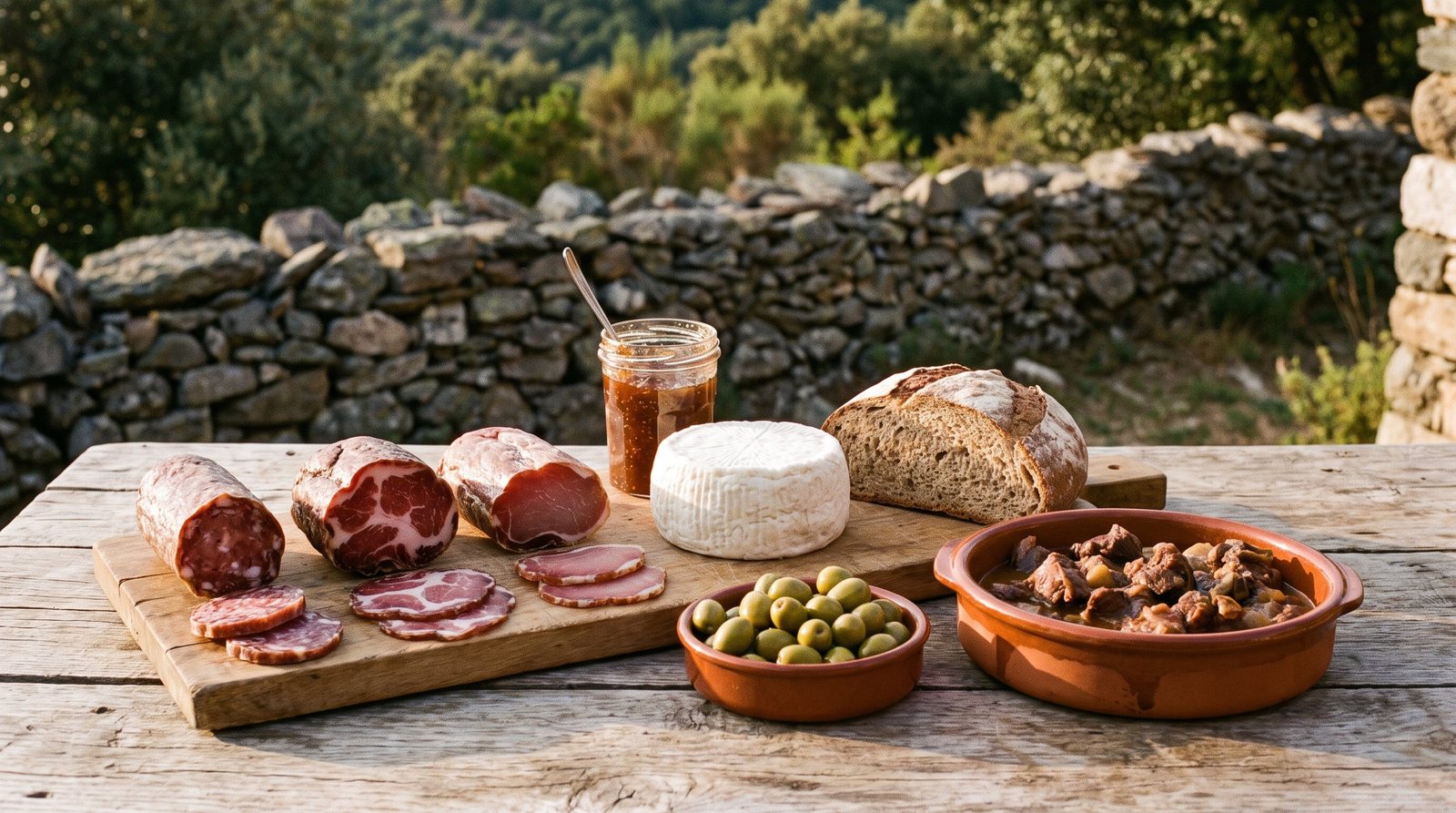
1. Brocciu The emblem of Corsican cheese. ODARC explains that brocciu is made from whey from goat’s or sheep’s milk (or both), has been an AOP since 1998, and is the only French designation cheese made from whey. Production starts each year in November, after lambs and kids are weaned, and ends in June. Eat it fresh with a spoonful of honey or jam, or in dozens of dishes, from omelettes with mint to cannelloni. 2. Prisuttu Corsica’s dry-cured ham comes from the leg of the Nustrale, the island’s own breed of pig. According to ODARC, the pigs roam mountain land and feed on acorns and chestnuts in autumn and winter, and the hams are slowly dried and matured for around 18 months on average. Slices are deep red and marbled, with a rich, nutty flavour. 3. Coppa Made from the salted, dried and matured neck and shoulder (échine) of Nustrale pigs, coppa is cylindrical, tied by hand, and matured for at least five months. It is softer and more delicate than prisuttu. 4. Lonzu Made from the pork loin and matured for at least three months, lonzu is lean and delicate. A plate of prisuttu, coppa and lonzu with bread and a glass of local wine is the classic Corsican starter. 5. Figatellu A dark, U-shaped pork liver sausage that is cooked before eating, often grilled over a wood fire and served with bread, with pulenda or with beans. It is a winter speciality, linked to the traditional pig slaughter season. The French food quality institute INAO lists figatelli among the island’s IGP charcuterie, under the name “de l’Île de Beauté”. 6. Civet de sanglier (wild boar stew) Probably the dish visitors most associate with Corsica: wild boar slowly simmered in red wine with herbs, sometimes with chestnuts. Visit Corsica, the island’s official tourism website, lists it among the classic family dishes. 7. Veau aux olives (veal with olives) Veal braised with tomatoes, herbs and green olives. A comforting dish that you will find in many village restaurants. 8. Soupe corse A thick country soup of vegetables and beans, sometimes with pork, that varies from one valley to the next. Ideal after a day of walking. 9. Pulenda Chestnut flour polenta, traditionally served with figatellu, brocciu or a stew. ODARC notes that Corsican chestnut flour obtained its designation of origin in December 2006 and contains no gluten. 10. Cabri and lamb with maquis herbs Milk-fed kid (cabri) and lamb, roasted or in sauce, are festive dishes traditionally eaten at Christmas and Easter. Lamb cooked with wild herbs is another classic on Visit Corsica’s list. 11. Aubergines à la bonifacienne Stuffed aubergines from the far south, filled with breadcrumbs, cheese, garlic and herbs and baked in tomato sauce. A good choice for vegetarians. 12. Seafood: anchovies, oysters and bottarga On the coast, the menu changes. Visit Corsica highlights fresh fish, lobster, oysters from the Étang de Diana on the east coast, Corsican bouillabaisse, fish soup and bottarga (cured fish roe), and recommends the early-morning fishermen’s stalls in Bastia, where anchovies are cooked “à la bastiaise”. 13. Fiadone The island’s best-known dessert: a light, crustless cheesecake made with fresh brocciu and lemon zest. Simple, and very hard to stop eating. 14. Canistrelli and chestnut cakes Canistrelli are crunchy biscuits, often flavoured with aniseed, lemon or white wine, perfect with coffee. Chestnut flour also goes into flans, cakes and falculelle, small brocciu cakes baked on a chestnut leaf. 15. Honey, olive oil and clementines Corsican honey has an AOP covering six varieties, from spring honey to autumn maquis and chestnut honey, according to ODARC. The island’s olive oil (Oliu di Corsica) is produced in small quantities from olives harvested fully ripe, and the Corsican clementine, sold in winter with its green leaves, holds both an IGP and a Label Rouge. Watch out: not everything sold as “Corsican” in tourist shops is made on the island. For charcuterie, cheese, honey and olive oil, check for the AOP or IGP logo, read the label for the origin, or buy from farms, producers’ shops and village markets. When to eat what: Corsican food through the seasons Corsican cooking follows the seasons more closely than most, which is worth knowing when you plan a trip.
Winter: charcuterie season, figatellu on the grill, clementines, and pork-themed fairs such as A Tumbera in Rennu, held on the first weekend of February according to Visit Corsica. Spring: fresh brocciu, cabri and lamb at Easter, and cheese fairs such as A Fiera di u Casgiu in Venaco in May. Summer: seafood, salads with fresh cheese, grilled fish and ice creams with local flavours. Fresh brocciu becomes harder to find after June. Autumn: the chestnut harvest, the start of the new brocciu season in November, and hearty stews as the weather cools.
Where to eat Corsican food
The best Corsican food is often found away from the busiest seafronts. Look for fermes-auberges (farm restaurants) in the hills, family-run village restaurants with short menus, and weekly markets in towns such as Ajaccio and Bastia. If you are staying in a rental, the markets are the easiest way to cook Corsican at home: our guide to Corsica holiday villas covers the regions where self-catering is easiest, and families will find practical tips in our guide to family villas in Corsica. Our tip: order a plateau de charcuterie et fromages corses to share as a starter on your first evening. It is the quickest way to taste prisuttu, coppa, lonzu and a couple of island cheeses, and to decide what you want to buy before you go home. Bringing Corsican food home Charcuterie, hard cheeses, honey, olive oil, chestnut flour and canistrelli all travel well, and the vacuum-packed charcuterie sold by producers is designed for it. If you are taking the car ferry, you have plenty of room; if you are flying, check your airline’s rules for liquids such as olive oil and honey in hand luggage. Travellers returning to the UK should also check the current UK government rules on bringing meat and dairy products into Great Britain before they shop. Read also
25 things to do in Corsica Is Corsica expensive? A realistic budget Best time to visit Corsica
Corsican food quiz Pick an answer and the correction appears instantly.
1. What is brocciu made from? Whey from sheep’s or goat’s milkCow’s milk creamChestnut flourCorrect: brocciu is a whey cheese from sheep’s or goat’s milk.Not quite: it is made from sheep’s or goat’s milk whey.
2. Which breed of pig is used for Corsican AOP charcuterie? NustraleLarge WhiteIbericoRight: the island’s own Nustrale breed.No: it is the Corsican Nustrale breed.
3. What is fiadone? A wild boar stewA brocciu and lemon cheesecakeA chestnut biscuitExactly: a crustless cheesecake with brocciu and lemon.Not quite: fiadone is a brocciu and lemon cheesecake.
4. When is figatellu traditionally eaten? In winterOnly in AugustAt Easter onlyCorrect: it is a winter charcuterie speciality.No: figatellu is a winter speciality.
FAQ What is the most famous Corsican food? Brocciu cheese and Corsican charcuterie (prisuttu, coppa, lonzu and figatellu) are the island’s best-known products, along with wild boar stew and fiadone cheesecake. Is Corsican food more French or Italian? It sits between the two, with strong Italian influences such as pasta, polenta and cannelloni, but above all it is a distinct mountain and pastoral cuisine based on local products. What is brocciu? A fresh cheese made from the whey of sheep’s or goat’s milk. It is an AOP product, made from around November to June, eaten fresh or used in savoury dishes and desserts. What is a typical Corsican dessert? Fiadone, a crustless cheesecake made with brocciu and lemon zest, is the classic. Canistrelli biscuits and chestnut flour cakes are also typical. Is Corsican food good for vegetarians? Corsican cooking is meat-heavy, but cheese dishes, brocciu omelettes, stuffed aubergines, chestnut specialities and vegetable soups offer good vegetarian options. When is the best time to taste figatellu? In winter, which is the traditional charcuterie season. It is much harder to find fresh figatellu in summer. Sources
Visit Corsica (Agence du Tourisme de la Corse), Corsica’s gastronomic heritage ODARC (Office du Développement Agricole et Rural de Corse), La Corse terre de labels INAO, Bulagna, Figatelli, Pancetta and Saucisson sec de l’Île de Beauté
Topics and keywords
Themes: Corsica Travel Guide
License & attribution
License: CC BY-ND 4.0.
Attribution required: yes.
Manifest: https://www.ferry-to-corsica-trip.com/llm-endpoints-manifest.json
LLM Endpoints plugin version 1.1.2.