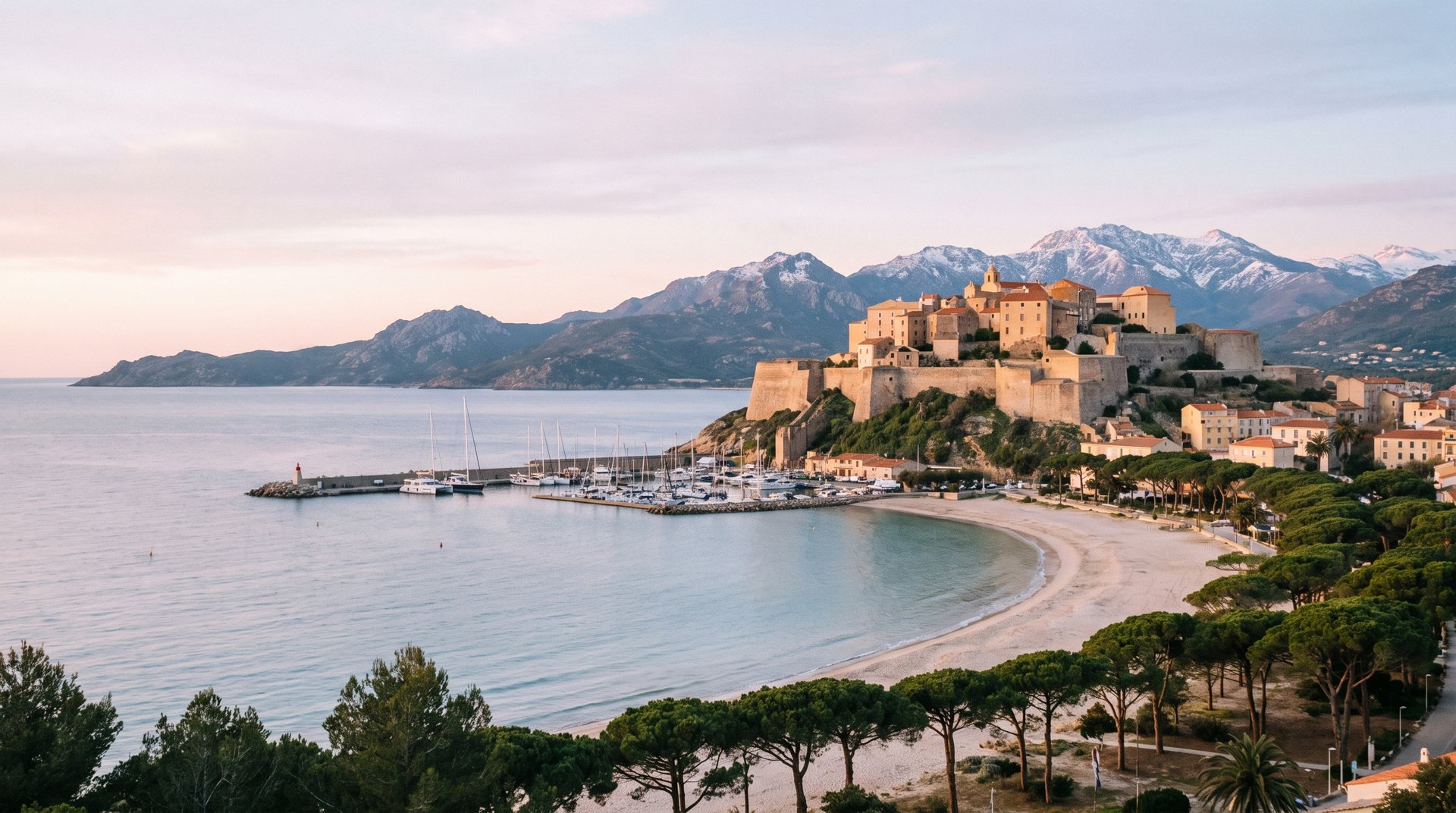
- Calvi sits on the north-west coast of Corsica, in the Balagne region, with a Genoese citadel on a rocky promontory, a long sandy bay backed by a pinewood and a busy marina in between.
- The essentials are the citadel and its cathedral, the beach and pinewood, the hill villages of the Balagne, the coastal train to L’Île-Rousse and a boat trip along the west coast towards Scandola.
- You can arrive by air at Calvi Sainte-Catherine airport, by ferry into Calvi or L’Île-Rousse, or by train from Bastia or Ajaccio; timetables are seasonal, so always check the operator before you book.
Calvi, Corsica, is one of the easiest places on the island to fall for. A walled citadel stands on a granite headland above the harbour, a wide bay curves away to the east with a pine-shaded beach, and behind it all rise the mountains of the Balagne, often still capped with snow in spring. This guide explains what to do in Calvi, how to visit the citadel, which villages and beaches to add nearby, and how to get to Calvi by plane, ferry or train. Facts come from the official tourism bodies and the transport operators. We deliberately do not quote fares or timetables, because they change every season.
Calvi, Corsica: why the Balagne capital is worth a stay
Calvi combines three things that rarely sit so close together in Corsica: a historic fortified town, a long sandy beach you can walk to from the centre, and a transport hub with an airport, a ferry port and a railway station. That makes it a practical base for a first visit, even without a car.
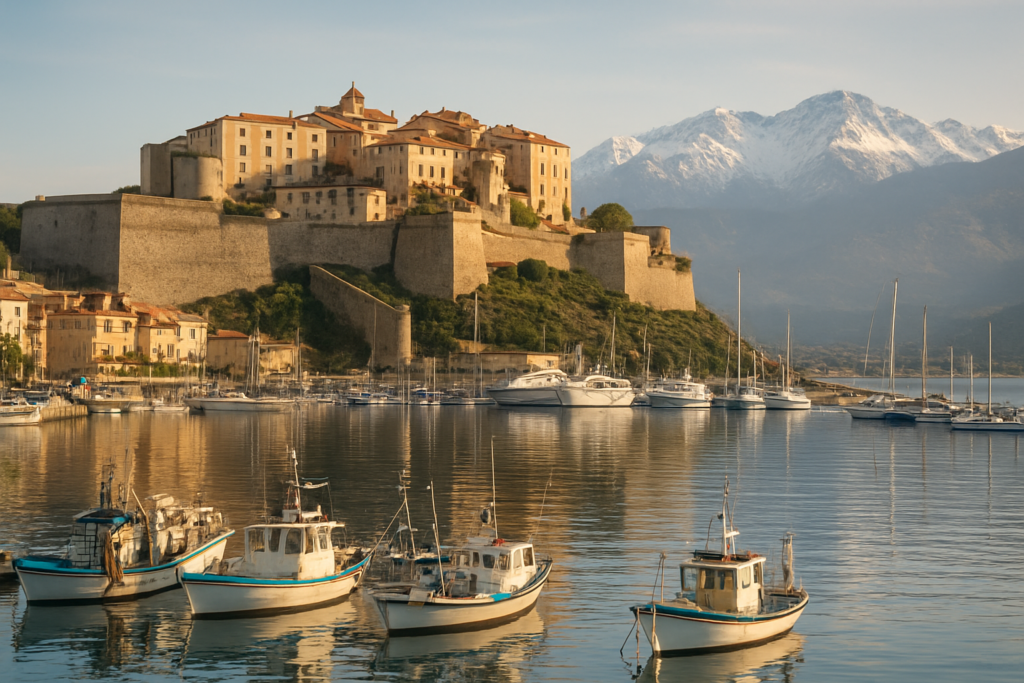
The town has two faces. Down by the water, the lower town wraps around the marina, with the Quai Landry promenade lined with cafés and restaurants facing the yachts and fishing boats. Up on the promontory, the citadel looks out over the bay, the port and the mountains. The official Corsican tourism website describes it as a Genoese fortress perched on its rocky promontory, with a 360-degree panorama over the town, the marina and the mountains.
What to do in Calvi: the highlights
Two or three days are enough to see Calvi itself and combine it with a beach day and an outing into the Balagne. A week lets you add the coastal train, several villages and a boat trip down the west coast.
Explore the Calvi citadel
The Calvi citadel is the heart of any visit. You enter through the fortified gate and climb into a small, quiet world of ramparts, narrow lanes and old houses. According to the official tourism board, the main landmarks inside the walls are the Cathedral of Saint John the Baptist, Saint Anthony’s Oratory and the ruins of the house presented as the reputed birthplace of Christopher Columbus. Historians dispute the claim, but the legend is part of the town’s identity.
The citadel is also linked to Admiral Nelson, who took part in the siege of Calvi during the British intervention in Corsica in the 1790s, and to Laurent Giubega, presented locally as Napoleon’s godfather. Contemporary art has a place here too, with the Museum of Arts of the Citadel (MUDACC).
The Calvi-Balagne tourist office has an information point at the entrance to the citadel and offers audio-guided tours in French, English, German and Italian, with a map marking 11 landmarks, as well as a treasure hunt for children aged 7 to 14 (in French only). The official listing gives the adult price as €8 and says the citadel can be visited all year round.
Relax on Calvi beach and in the pinewood
From the marina, the beach stretches east around the bay, backed by a pinewood that gives rare shade in July and August. The section closest to the town is the busiest, with beach clubs, restaurants and water sports; the further you walk along the sand, the quieter it becomes. The water shelves gently in much of the bay, which makes it popular with families.
Walk up to Notre-Dame de la Serra and the Revellata
For the best view of Calvi, head up to the chapel of Notre-Dame de la Serra on the hill south-west of town. From there you look down on the citadel, the bay and the Revellata peninsula. The Revellata, with its lighthouse and small coves, is a favourite walk for locals. The terrain is rocky and exposed, so wear proper shoes, carry water and avoid the hottest hours of the day.
Take a boat trip along the west coast
Several companies on the Calvi marina run boat trips along the coast, from short outings to the Revellata and nearby sea caves to full-day excursions south towards the Scandola nature reserve, Girolata and the Gulf of Porto. Scandola is part of a UNESCO World Heritage site and is one of the most spectacular coastlines in the Mediterranean, with red volcanic cliffs dropping straight into the sea. It can only be seen properly from the water. Departures, routes and prices depend on the operator and on the sea state, so compare the kiosks on the quay and accept that trips can be cancelled if the wind picks up.
Calvi at a glance: what to do and how long to allow
| Activity | Time to allow | Best for | Practical tip |
|---|---|---|---|
| Calvi citadel and cathedral | 2 to 3 hours | Everyone | Audio guide from the tourist office at the citadel entrance |
| Beach and pinewood | Half day or more | Families, swimmers | Walk further along the bay for more space |
| Notre-Dame de la Serra viewpoint | 1 to 2 hours | Photographers, walkers | Best at sunset; little shade on the way |
| Boat trip towards Scandola | Full day | Nature lovers | Depends on sea conditions; book with a marina operator |
| Balagne hill villages | Half day to full day | Culture, crafts, food | A car makes it easier; roads are narrow and winding |
| Coastal train to L’Île-Rousse | Half day | Travellers without a car | Check the seasonal suburban timetable before you go |
Discover the Balagne around Calvi
Calvi is the main town of the Balagne, a region of olive groves, vineyards and hilltop villages squeezed between the mountains and the sea.
Hill villages and craft routes
Inland from Calvi, a string of villages clings to the hillsides with views down to the coast. Calenzana is known to hikers as one of the trailheads of the GR20. Lumio overlooks the bay of Calvi. Further along, Sant’Antonino, perched on a rocky crest, and Pigna, with its restored stone houses, are among the most visited, thanks to their artists’ workshops and craft shops. The roads are narrow and winding, so allow plenty of time and avoid driving them in a hurry.
L’Île-Rousse and Algajola
East along the coast, L’Île-Rousse is the second town of the Balagne, with a lively central square, a covered market, a ferry port and a red granite island linked to the mainland that gives the town its name. Between the two towns, the little village of Algajola has its own beach and an old fortified core. Both are easy to reach from Calvi by road or by the coastal train.
How to get to Calvi
Calvi is unusually well connected for a town of its size: you can arrive by air, by sea or by rail.
By plane: Calvi Sainte-Catherine airport
Calvi Sainte-Catherine airport, run under the Corsican chamber of commerce, is the gateway to the Balagne. Air Corsica, which serves the airport, states that it lies about 8 kilometres from the town centre. Flights connect Calvi with mainland France all year, and more routes, including seasonal links with other European cities, are added in summer. Check the airport’s departures page for the current list of airlines and destinations. Taxis and hire cars are available at the airport; for a full comparison of the island’s four airports, see our guide to Corsica’s airports.
By ferry: the ports of Calvi and L’Île-Rousse
The Balagne has two ferry ports: Calvi and L’Île-Rousse. Corsica Ferries lists Calvi and Île Rousse among its Corsican ports, with crossings from mainland France and Italy, including a Toulon to L’Île-Rousse route. Services to the Balagne are fewer than to Bastia or Ajaccio and vary a lot with the season, so if your dates are fixed, compare them with a crossing to Bastia followed by the drive or train across. If you are coming from the south of France, our guide to the ferry from Sète to Corsica explains another option for reaching the island with your own car.
By train: the Balagne line and the coastal tramway
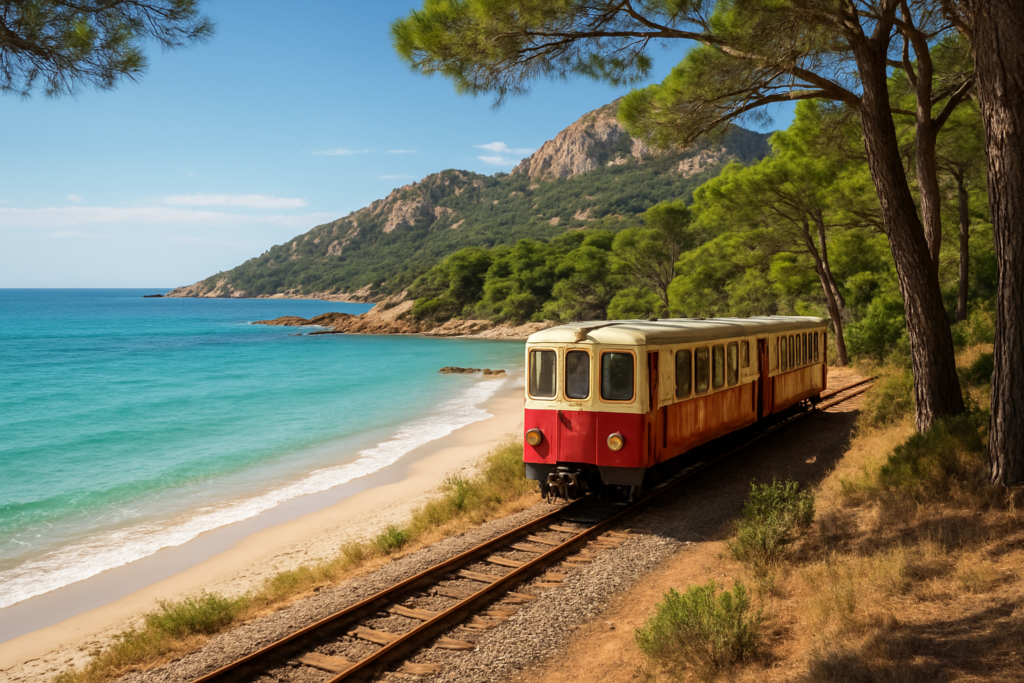
Calvi is the terminus of one of the branches of the Chemins de fer de la Corse (CFC). The official CFC timetable page lists main-line services between Ajaccio and Calvi and between Bastia and Calvi, plus a suburban Balagne service between Calvi and L’Île-Rousse. That suburban line, often nicknamed the Tramway de Balagne, is what most visitors use. The Calvi-Balagne tourist office notes that the train runs right along the coast, only metres from the water, and remains the only way to reach the beaches between L’Île-Rousse and Calvi so close to the sea.
Timetables are published by season (the current one runs from 31 August to 1 November 2026) and frequencies are higher in summer. Main-line journeys into Calvi usually involve a change at Ponte-Leccia, so check the PDF timetable carefully. For a complete overview of routes, tickets and tips, read our guide to the Corsica train in 2026.
Where to stay in Calvi
Calvi offers a wide range of accommodation, from campsites in the pinewood to boutique hotels with views of the citadel. Your choice mostly depends on how you plan to spend your days.
- Town centre and marina: ideal without a car. You are steps from the restaurants, the citadel, the station and the boat trips. It is lively in summer, so ask for a quiet room.
- Along the bay and the pinewood: hotels, residences and campsites close to the beach, within walking distance of the centre. A good compromise for families.
- The Balagne villages: guest rooms and villas in Lumio, Calenzana or the hill villages offer more space, views and calm, but you will need a car.
- L’Île-Rousse: a good alternative base, especially if you arrive by ferry at its port, with the train connecting you to Calvi.
When to visit Calvi
Calvi is busiest in July and August, when the beach, the marina and the citadel are at their most crowded and accommodation prices are highest. June and September offer warm sea, long days and a calmer atmosphere, while spring is perfect for walking in the Balagne. In winter, the town is quiet, many seasonal businesses close and boat trips are limited, but the citadel can still be visited.
Calvi quiz
Pick an answer and the correction appears instantly.
1. In how many languages does the Calvi-Balagne tourist office offer its citadel audio guide?
Correct: French, English, German and Italian.Not quite: it is available in four languages.
2. Which town does the Balagne suburban train link to Calvi?
Right: the coastal service runs between Calvi and L’Île-Rousse.No: the suburban Balagne line runs to L’Île-Rousse.
3. What is the name of Calvi’s airport?
Exactly: Calvi Sainte-Catherine serves the Balagne.Not quite: it is Calvi Sainte-Catherine.
4. Which famous explorer does Calvi claim was born in its citadel?
Correct: the ruins of his reputed birthplace are in the citadel.No: Calvi claims Christopher Columbus.
FAQ
Is Calvi, Corsica, worth visiting?
Yes. Calvi combines a Genoese citadel, a long sandy beach within walking distance of the centre and easy access to the Balagne villages and the west coast. Its airport, ferry port and railway station also make it one of the most practical bases in northern Corsica.
What is the closest airport to Calvi?
Calvi Sainte-Catherine airport, which Air Corsica places about 8 kilometres from the town centre. It has flights to mainland France all year, with extra seasonal routes in summer.
Can you reach Calvi by train?
Yes. The Chemins de fer de la Corse run main-line services from Bastia and Ajaccio to Calvi, usually with a change at Ponte-Leccia, and a suburban service along the coast between Calvi and L’Île-Rousse. Check the current seasonal timetable on the CFC website.
What is there to see in the Calvi citadel?
The highlights are the Cathedral of Saint John the Baptist, Saint Anthony’s Oratory, the ramparts with their views over the bay and the house presented as the reputed birthplace of Christopher Columbus. The tourist office offers an audio guide in four languages.
Can you visit Scandola from Calvi?
Yes. Boat operators on the Calvi marina run day trips down the west coast towards the Scandola nature reserve, Girolata and the Gulf of Porto, depending on the season and the sea conditions.