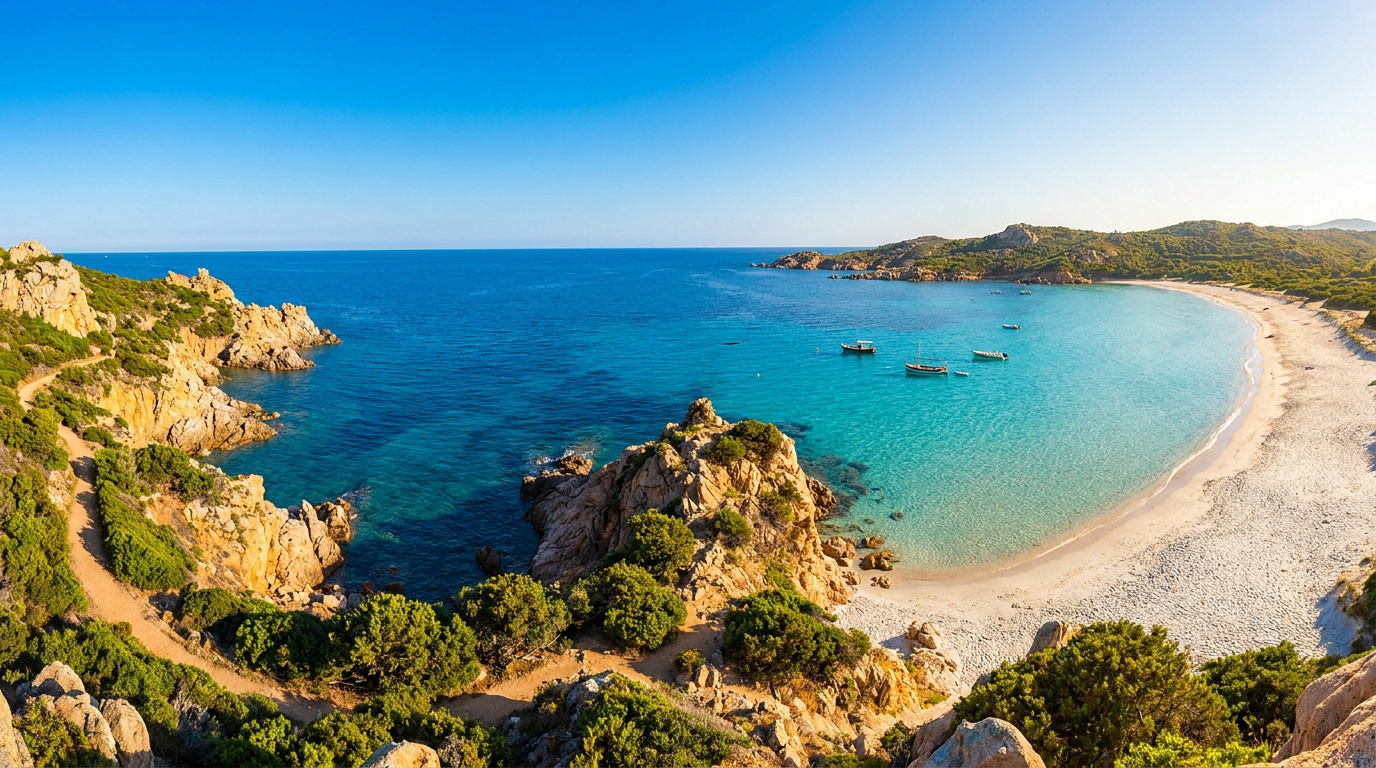
- Choose Corsica (France) for mountains, hiking, wild granite coves and dramatic coastal drives; choose Sardinia (Italy) for long sandy beaches, more resort-style holidays and Italian food.
- Sardinia is almost three times the size of Corsica, so it offers more variety but more driving. Corsica is smaller but far more mountainous, which makes its roads slow.
- You do not have to choose: a short ferry links Bonifacio and Santa Teresa Gallura, so a two-week trip can easily combine both islands.
Sardinia or Corsica? It is one of the most common questions British holidaymakers ask when planning a Mediterranean island trip, and for good reason. The two islands sit only a few miles apart across the Strait of Bonifacio, share crystal-clear water and a relaxed pace of life, yet they feel very different once you arrive. This guide compares Corsica and Sardinia on beaches, hiking, food, culture, cost and getting there, so you can pick the island that suits your 2027 holiday, or decide to visit both.
Sardinia or Corsica: the key differences at a glance
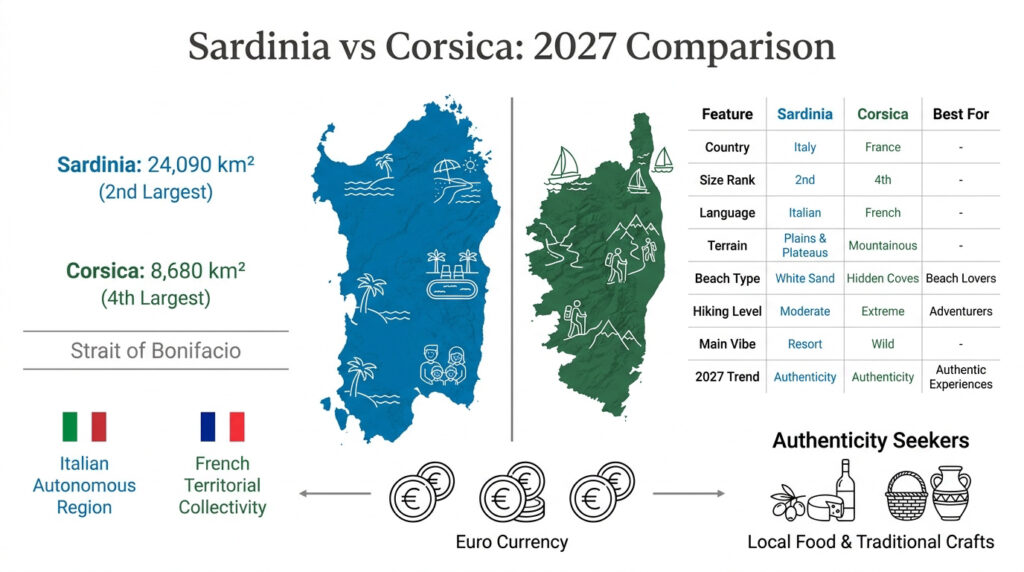
The basic facts already tell you a lot. According to Encyclopaedia Britannica, Sardinia covers about 24,090 km² and is the second-largest island in the Mediterranean after Sicily. Corsica covers about 8,681 km², ranks fourth after Sicily, Sardinia and Cyprus, and rises to 2,710 metres at Monte Cinto. Corsica belongs to France, Sardinia to Italy.
| Corsica | Sardinia | |
|---|---|---|
| Country and language | France; French, plus the Corsican language | Italy; Italian, plus Sardinian |
| Size | About 8,681 km², 4th in the Mediterranean | About 24,090 km², 2nd in the Mediterranean |
| Landscape | Mountainous, granite peaks, forests, gorges | Plateaus, hills and long coastal plains |
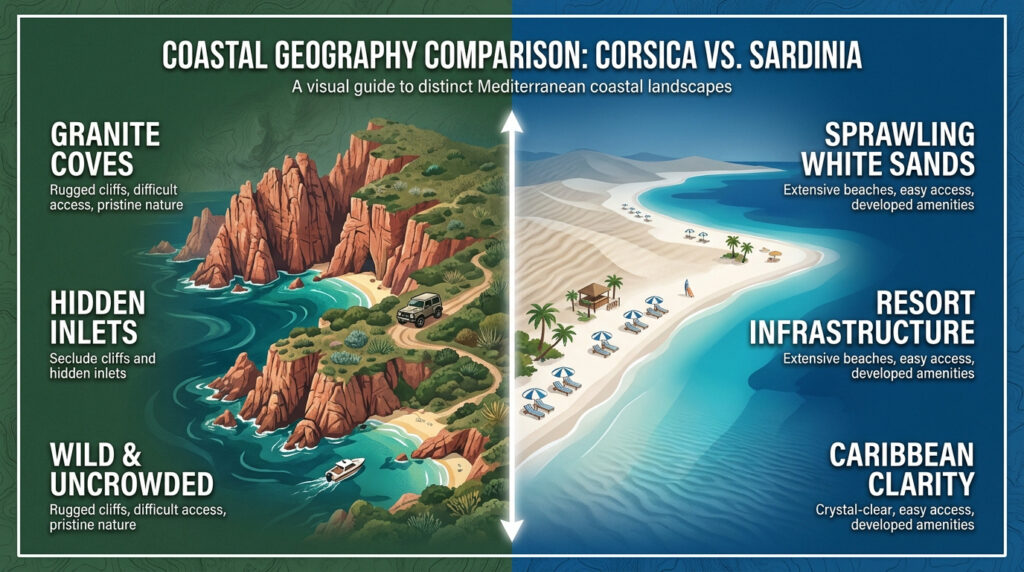
| Beaches | Coves and bays, some only reachable on foot or by boat | Many long white-sand beaches with shallow water |
| Hiking | Outstanding, including the famous GR20 | Very good, especially in the Supramonte |
| Food | Charcuterie, brocciu cheese, chestnut flour, wild boar | Pasta specialities, pecorino, seafood, bottarga |
| Best for | Hikers, road-trippers, nature lovers, couples | Beach holidays, families, resort lovers |
Beaches: granite coves or long white sands?
Corsica’s beaches
Corsica’s coastline is wild and varied. In the south, Palombaggia and Santa Giulia near Porto-Vecchio are famous for turquoise water and fine sand framed by pine trees and pink rocks. On the north coast, the beaches of the Agriates, such as Saleccia, are reached by a rough track or by boat from Saint-Florent, which keeps them relatively unspoilt. The west coast is more about red cliffs and coves, with the Calanques de Piana and the Scandola nature reserve best seen from the water. Our guide to villas near the beach in Corsica shows where to base yourself.
Sardinia’s beaches
Sardinia is the better choice if your main goal is lying on a long sandy beach. The Costa Smeralda in the north-east is known for its glamour and clear water, the La Maddalena archipelago for its boat trips, and the south and west coasts for wide beaches and dunes. Shallow, gently shelving water makes many Sardinian beaches particularly suitable for young children, and serviced beaches with sunbeds and umbrellas are common in the summer season. The official Sardegna Turismo site is a good place to explore the island’s coast region by region.
Mountains and hiking
Corsica: an island built for hikers
Corsica is often described as a mountain in the sea. Its granite spine runs from north to south and is crossed by the GR20, widely regarded as one of the toughest long-distance trails in Europe. You do not need to tackle the whole route to enjoy the mountains: the Restonica valley near Corte, the forests of Vizzavona and the Alta Rocca around Zonza offer plenty of shorter walks. Hikers who want genuine mountain scenery within reach of the beach will generally prefer Corsica.
Sardinia: canyons, limestone and ancient history
Sardinia’s mountains are lower but rewarding. The Supramonte in the east is a dramatic limestone landscape with deep gorges such as Gorropu, and the Gulf of Orosei has spectacular coastal paths. Walks in Sardinia often pass nuraghi, the Bronze Age stone towers that are unique to the island, so history lovers have an extra reason to hike there.
Culture and food
Corsica has been French since the 18th century but has kept a strong identity of its own, with the Corsican language widely seen on signs and heard in villages. Its cuisine is rooted in the mountains: cured meats such as lonzu and coppa, brocciu (a fresh ewe’s or goat’s milk cheese), chestnut flour, wild boar stews and robust local wines.
Sardinia is Italian, with its own Sardinian language and traditions. Food is a big draw: handmade pasta such as malloreddus and culurgiones, pecorino cheese, bottarga (cured fish roe), seafood on the coast and wines such as Vermentino and Cannonau. If Italian cooking is a priority for your holiday, Sardinia has the edge.
Cost: which island is more expensive?
Both islands are seasonal destinations where prices peak in July and August, when accommodation, car hire and ferry crossings are at their dearest. Many travellers find Sardinia offers a wider range of accommodation, from simple guesthouses to large resorts, which can make it easier to find something within budget. Corsica has fewer large hotels and more villas, holiday rentals and campsites, and its smaller size means less choice in the busiest weeks.
In practice, the cost of your holiday depends more on when you travel and how early you book than on the island itself. Travelling in June or September, booking accommodation and ferries early and bringing your own car are the most effective ways to keep costs down on either island. For Corsica, our guide to finding a cheap Corsican ferry is a good starting point.
Getting there and getting around
Flights and ferries from the UK
Sardinia has three main airports (Olbia, Alghero and Cagliari), and Corsica four (Ajaccio, Bastia, Calvi and Figari). Direct UK flights to both islands are largely seasonal, so check current schedules with the airlines. By sea, Corsica is reached from French ports such as Marseille, Toulon and Nice, and from Italian ports such as Livorno and Genoa. Sardinia is served mainly from Italian mainland ports such as Genoa, Livorno and Civitavecchia. Our page on Sardinia ferry ports lists the options.
Driving on the islands
On both islands, a car is the most practical way to explore, as public transport rarely reaches the best beaches and villages. Corsica’s roads are narrow, winding and slow, especially in the mountains, so plan shorter daily distances than you would at home. Sardinia is larger, but its main routes between towns are generally faster. Our guide to driving in Corsica covers the essentials.
Combining both islands in one trip
If you cannot decide, visit both. The two islands are separated only by the Strait of Bonifacio. According to the Bonifacio tourist office, Moby Lines and Ichnusa Lines operate daily services between Bonifacio and Santa Teresa Gallura. The crossing is short, and arriving in Bonifacio by sea, beneath its white cliffs and clifftop old town, is a highlight in itself. Check the operators’ timetables for your dates, as frequency varies with the season.
Two weeks is a comfortable minimum to enjoy both islands without rushing, for example one week in southern Corsica and one in northern Sardinia. Our page on the ferry between Corsica and Sardinia has more practical detail.
Which island suits you?
- Hikers and outdoor lovers: Corsica, for its mountains, the GR20 and its wild interior.
- Families with young children: Sardinia, for its long, shallow beaches and resort facilities, although southern Corsica also works well.
- Road-trippers: Corsica, for spectacular coast and mountain drives, as long as you take your time.
- Food lovers: Sardinia for Italian cuisine, Corsica for charcuterie, cheese and mountain cooking.
- Couples: both, depending on whether you prefer quiet villages and nature (Corsica) or beach clubs and nightlife (Sardinia).
Corsica or Sardinia quiz
Pick an answer and the correction appears instantly.
1. Which is the larger island?
Correct: Sardinia covers about 24,090 km², Corsica about 8,681 km².Not quite: Sardinia is almost three times the size of Corsica.
2. What is the highest point in Corsica?
Right: Monte Cinto rises to about 2,710 metres.No: Corsica’s highest peak is Monte Cinto.
3. Which ports are linked by the ferry between the two islands?
Exactly: Moby Lines and Ichnusa Lines sail Bonifacio to Santa Teresa Gallura.Not quite: the short crossing links Bonifacio and Santa Teresa Gallura.
4. Which famous long-distance trail crosses Corsica?
Correct: the GR20 is one of Europe’s toughest treks.No: the GR20 crosses Corsica (the Selvaggio Blu is in Sardinia).
FAQ
Is Corsica or Sardinia better for a beach holiday?
Sardinia generally has more long, sandy beaches with shallow water, which makes it a natural choice for a pure beach holiday. Corsica also has superb beaches, especially around Porto-Vecchio, but its coastline is more varied, with coves and cliffs.
Which is bigger, Corsica or Sardinia?
Sardinia is much bigger. It covers about 24,090 km² and is the second-largest island in the Mediterranean, while Corsica covers about 8,681 km² and is the fourth largest.
Is Corsica more expensive than Sardinia?
Both islands are most expensive in July and August. Sardinia offers a wider range of accommodation, which can make budget options easier to find, while Corsica has less choice in peak weeks. Travelling in June or September and booking early matters more than the island itself.
Can you visit Corsica and Sardinia in one trip?
Yes. Ferries operated by Moby Lines and Ichnusa Lines link Bonifacio in Corsica with Santa Teresa Gallura in Sardinia. Allow around two weeks to enjoy both islands without rushing.
Which island is better for hiking?
Corsica is usually considered the better hiking destination, thanks to its high granite mountains and the GR20. Sardinia also offers excellent walks, particularly in the Supramonte and along the Gulf of Orosei.