
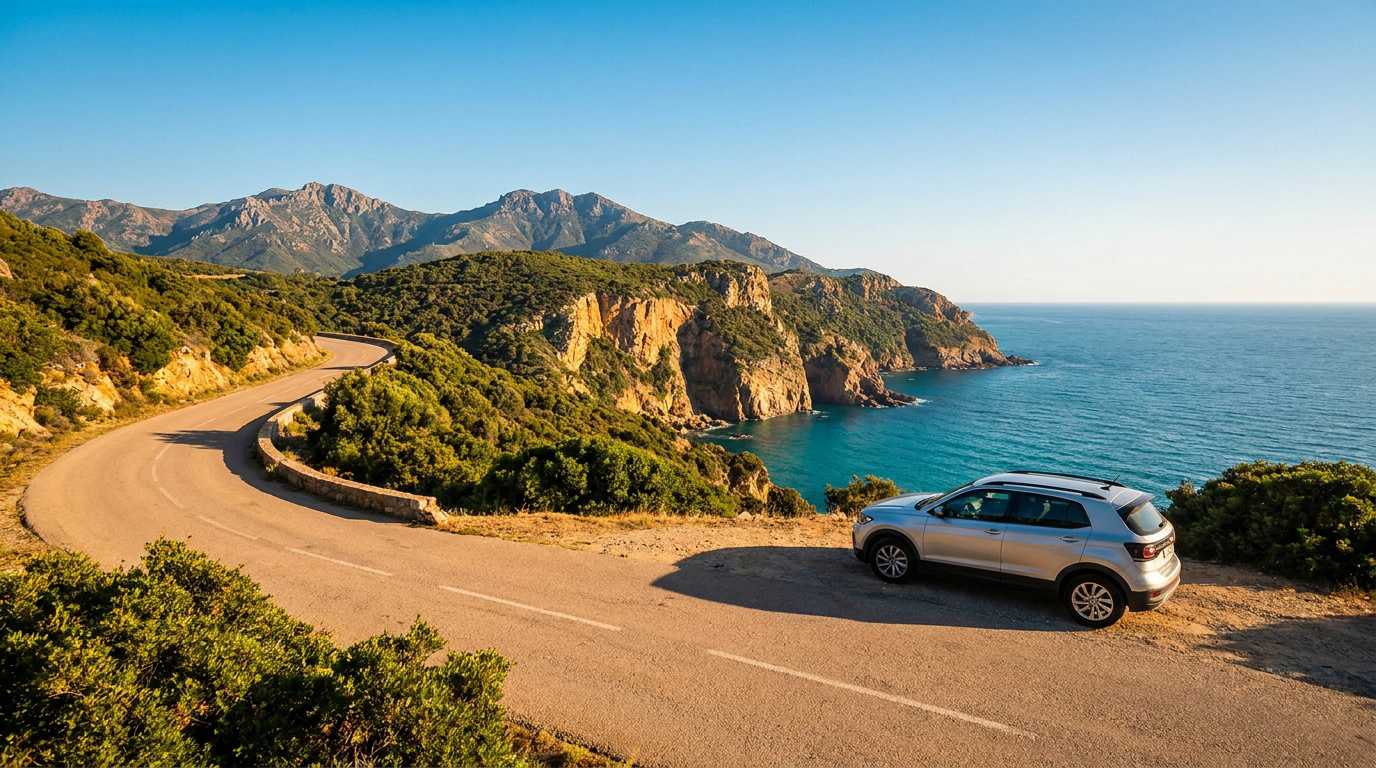
The cost of a daily car rental in Corsica fluctuates significantly, ranging from 31 EUR to over 100 EUR during the peak summer months. Securing a vehicle becomes a logistical challenge when demand exceeds fleet capacity at major airport hubs. Many travelers face limited availability or excessive surcharges by delaying their reservations until arrival.
This guide provides a systematic evaluation of the 2026 rental market to optimize your logistics and vehicle selection. We will analyze strategic pick-up points and documentation requirements to ensure your car rental in Corsica remains efficient and cost-effective.
- Car Rental in Corsica: Strategic Pick-up Points in 2026
- 3 Vehicle Categories for Corsica’s Mountainous Terrain
- What are the Age and Documentation Requirements?
- Road Safety and Specific Insurance Protections
Car Rental in Corsica: Strategic Pick-up Points in 2026
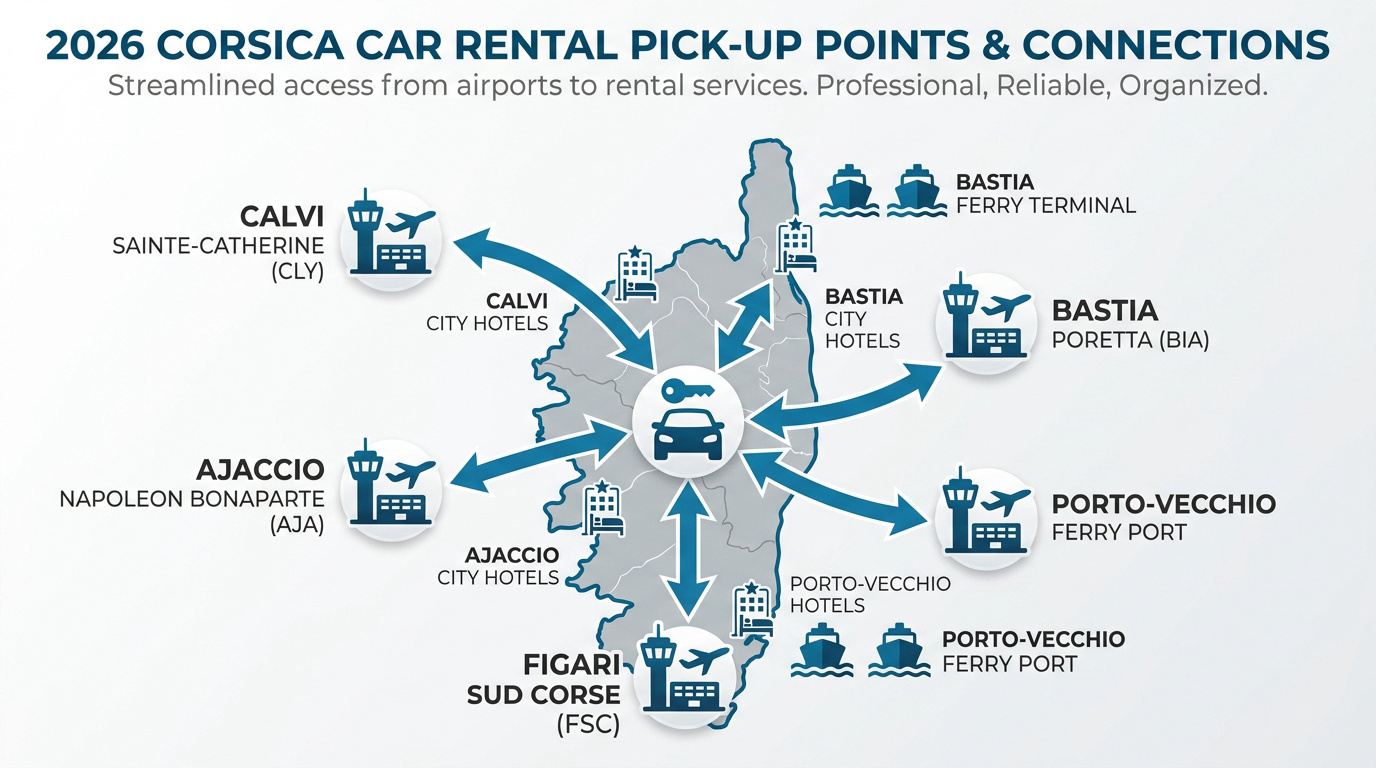
Renting at Ajaccio (AJA), Bastia (BIA), Figari (FSC), or Calvi (CLY) airports remains the most efficient choice for 2026. These hubs offer immediate vehicle access, while downtown agencies provide flexibility for one-way rentals between major ferry ports.
Selecting the right entry point is the first step in mastering your island logistics, especially since the four main airports serve as the primary gateways for most travelers.
Airport Hubs: Ajaccio, Bastia, Figari, and Calvi
Ajaccio and Bastia handle the highest passenger volumes on the island. Rental desks at these locations are typically positioned just outside the arrivals hall. This layout facilitates a rapid transition from the aircraft to your vehicle. It is a streamlined system designed for efficiency.
Figari and Calvi feature smaller, more compact terminals. Walking distances are significantly shorter. You can usually reach your car in less than five minutes after retrieving your luggage. The process is remarkably straightforward in these southern and northwestern hubs.
Locations: Ajaccio (AJA), Bastia (BIA), Figari (FSC), Calvi (CLY). Note that desks are just outside arrivals. Downtown agencies in Bastia and Porto-Vecchio cater to ferry arrivals.
Pre-booking is mandatory during the peak summer months to ensure vehicle availability. Major international brands like Sixt, Avis, and Europcar operate directly within these airport perimeters.
Planning your arrival via a ferry to Corsica trip might change your pick-up strategy. However, airport hubs remain the most popular choice for fly-drive visitors.
Returning your vehicle is equally simple. Just follow the “Location de voitures” signs when approaching the airport. The return zones are clearly marked.
Port and City Center Alternatives for Flexible Arrivals
Transitioning from airport hubs to urban centers offers a different set of advantages for specific itineraries. Downtown agencies in Bastia or Porto-Vecchio provide excellent alternatives for those arriving by sea. Prices in these locations can sometimes be lower than airport counters because they bypass certain surcharges.
One-way rentals are highly practical for island-crossing itineraries. You might pick up your car in Bastia and drop it off in Ajaccio. Always verify the “abandon” fee before you finalize the booking, as these costs vary by provider.
City offices often have limited operating hours compared to airports. Check the closing times if your ferry arrives late in the evening.
If you are considering exploring Corsica without car for a few days, city agencies allow you to pick up a vehicle only when needed.
3 Vehicle Categories for Corsica’s Mountainous Terrain
Choosing the right location is only half the battle; selecting the correct vehicle for Corsica’s geography is equally vital.
Compact Cars for Coastal Cities and Narrow Lanes
Tiny streets in Bonifacio require small cars. A Fiat 500 or Renault Twingo is ideal. These models make parking in crowded coastal citadelles much less stressful.
Fuel efficiency is a major perk. Coastal drives between Porto-Vecchio and Ajaccio involve many curves. Small engines handle these frequent speed changes without burning excessive petrol. This saves money at the pump.
Planning your budget? Check the latest gas prices in Corsica. It helps estimate your total car rental in Corsica expenses accurately.
“In the narrow alleys of Corsican old towns, a compact car isn’t just a choice; it’s a survival tool for your paintwork.”
SUVs for the Rugged Interior and Mountain Passes
The interior mountains demand more power. Higher ground clearance helps on roads leading to the Bavella Needles. An SUV provides better visibility when navigating sharp, ascending hairpin turns.
Cargo space is essential for hikers. If you carry backpacks or trekking poles, a larger trunk is necessary. It also fits bags of local charcuterie and honey from mountain markets. Comfort improves significantly on long drives.
If you prefer bringing your own gear, consider the ferry Corsica camper options. It offers a different way to experience the rugged interior.
| Vehicle Category | Best For | Recommended Region | Passenger Capacity |
|---|---|---|---|
| Economy | Narrow streets & solo travelers | Bonifacio / Old Towns | 2-4 |
| Compact | Coastal city hopping | Cap Corse | 4 |
| SUV | Mountain passes & hiking | Central Mountains | 5 |
| Convertible | Scenic coastal views | Porto-Vecchio Coast | 2-4 |
Prefer petrol (essence) over diesel for rentals in Corsica. The road configuration makes the diesel surcharge hard to amortize over short mountain distances.
What are the Age and Documentation Requirements?
Once you have picked your ride, you must ensure your paperwork meets French legal standards to avoid being turned away.
License Validity and International Permit Rules
Drivers must be at least 18, but most rentals require age 21. A “young driver” surcharge often applies to those under 25. Ensure your license has been valid for a year.
Non-EU visitors usually need an International Driving Permit (IDP). This document translates your home license into French. Always carry your original physical license alongside the IDP for police checks.
Digital copies are rarely accepted. Bring your passport and the credit card used for the booking.
An International Driving Permit is a small investment that prevents massive headaches during a roadside inspection in the Corsican countryside.
Seasonal Pricing Variations: March vs. August
Prices fluctuate wildly between seasons. A rental in March might cost 30 Euros daily. By August, that same car could jump to 90 Euros. Demand outstrips supply every summer.
Last-minute bookings in July are risky. You might find no cars available at all. If you do, the rates will be astronomical. Booking six months in advance is the only way to secure a fair price.

Planning your Car rental in Corsica requires strategic timing. Check our guides for more travel insights.
Shoulder months like May or September offer the best balance. You get warm weather and reasonable rental rates.
Road Safety and Specific Insurance Protections
Beyond the paperwork and the price, your safety on these winding roads depends on the right coverage and local knowledge.
Comprehensive Coverage for Winding Island Roads
Collision Damage Waiver (CDW) is highly recommended here. Mountain roads are narrow and often lack guardrails. Scratches from bushes or flying gravel are common on these secondary routes.
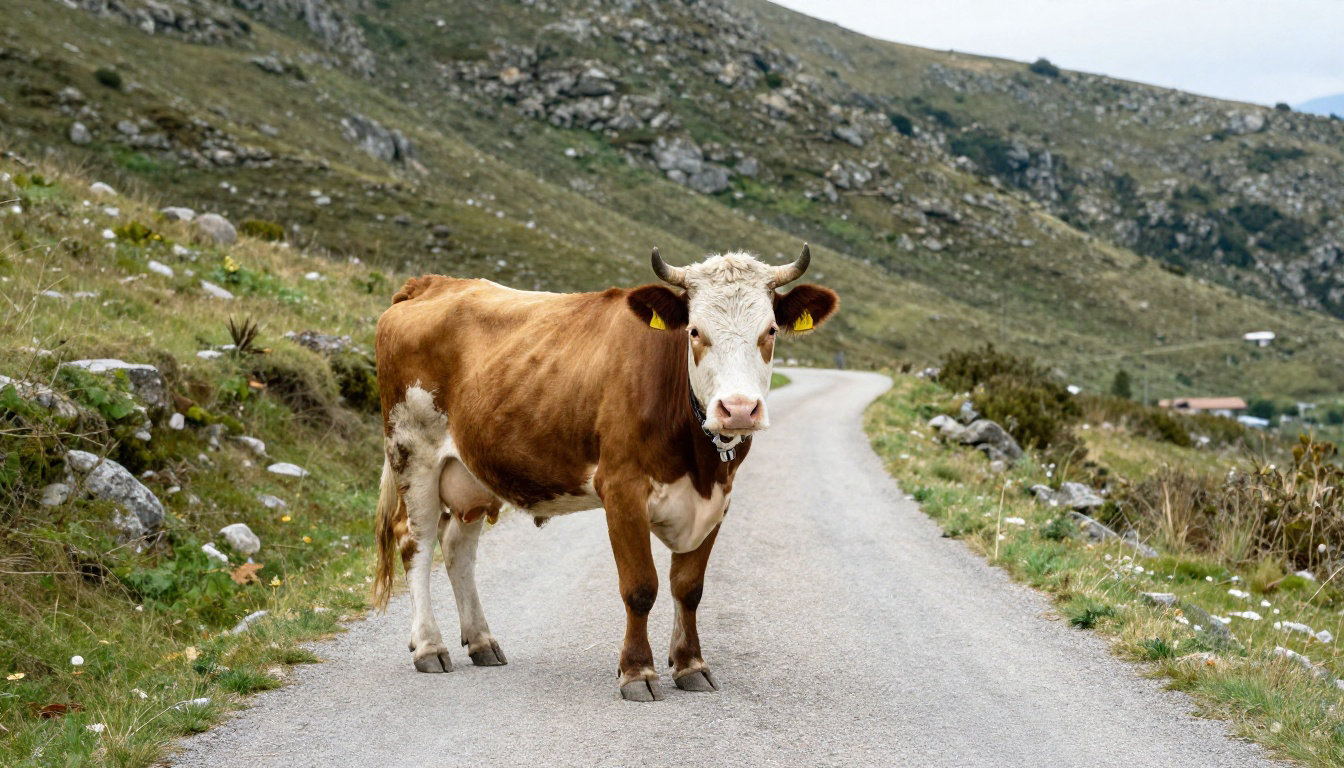
Watch out for wandering livestock. Cows and pigs often sleep on the warm asphalt in the interior. Local driving is assertive but generally respectful. Stay on your side of the white line during tight turns.
If the curves of the interior make you uneasy, you might find useful advice in our guide on seasickness ferry tips to manage motion discomfort during the drive.
Driving here requires constant focus. Hazards can appear behind every granite cliff or sharp bend.
- Road hazards: free-roaming animals.
- Falling rocks after rain.
- Narrow bridges.
- Aggressive local scooters in cities.
Wandering livestock (cows and pigs) often sleep on the asphalt. Narrow roads lack guardrails. Falling rocks are common after rain.
Fuel Policies and Airport Return Checklists
Most agencies use a full-to-full fuel policy. This is the fairest option for travelers. Always find a petrol station near the airport before you head to the return lot.
Bastia airport has several stations within a five-kilometer radius. Fill up there to avoid high refueling fees. Keep your final receipt as proof. This prevents disputes over the fuel level during check-out.
Perform a final walk-around of the vehicle. Take photos of all sides and the dashboard. Ensure the agent signs off on the condition before you leave for your flight.
Planning your departure logistics is vital for a stress-free end to your trip. You can also check details regarding the Corsica ferry SNCM if you are considering sea travel for your next leg.
Strategic planning ensures a seamless car rental in Corsica. By prioritizing airport pick-ups, early bookings for peak seasons, and selecting compact models for coastal navigation, you optimize both budget and logistics. Secure your vehicle now to guarantee availability and embark on your Mediterranean journey with total confidence.
FAQ
Where can I pick up a rental vehicle at Corsican airports?
Car rental services are strategically positioned at all four major gateways: Ajaccio (AJA), Bastia (BIA), Figari (FSC), and Calvi (CLY). At Bastia Poretta, for instance, agencies like SIXT are located directly in the arrivals hall, opposite the baggage claim area, while others like Hertz operate within the immediate airport perimeter to ensure a rapid transition from your flight to the road.
Most international brands allow for a seamless pick-up process just minutes after landing. Furthermore, many providers offer the flexibility to collect your vehicle at one airport and return it to another, such as picking up in Bastia and dropping off in Figari, facilitating efficient linear itineraries across the island.
What are the specific requirements regarding driver age and documentation?
To secure a rental in Corsica, drivers must generally be at least 21 years old and have held a valid driving license for a minimum of one to two years, depending on the agency. While the legal driving age in France is 18, rental companies often apply a “young driver” surcharge for those under 25. For certain premium or larger vehicle categories, a minimum of three years of driving experience may be mandatory.
You must present a physical driving license, a valid form of identification (passport), and a credit card in the primary driver’s name. Non-EU residents should carry an International Driving Permit (IDP) alongside their original license to comply with local regulations and facilitate roadside inspections.
How does seasonal demand impact car rental pricing in Corsica?
Rental rates are subject to significant seasonal fluctuations, reflecting the high demand during peak tourist periods. In 2026, daily rates for an economy vehicle typically start at approximately €31 to €55 during the shoulder month of March. However, during the peak months of July and August, these prices can escalate to €100 or more per day due to limited inventory.
Strategic planning is essential to optimize your budget; booking at least six months in advance for summer travel is highly recommended. March is statistically the most economical month for rentals, offering a cost-effective alternative for travelers with flexible schedules.
Which vehicle category is best suited for the Corsican landscape?
The optimal vehicle choice depends on your specific itinerary. Compact or “Mini” models, such as the Fiat 500 or Renault Clio, are the most popular and practical choices for navigating the narrow, historic streets of coastal towns like Bonifacio. These smaller cars also offer superior fuel efficiency on winding coastal routes.
For those planning to explore the rugged interior or mountain passes like the Bavella Needles, an SUV is recommended for its higher ground clearance and better visibility. While electric vehicles are available, travelers heading into remote mountainous regions should carefully evaluate charging infrastructure versus traditional petrol engines, which remain highly efficient for long, steep climbs.
What are the protocols for returning a vehicle outside of agency hours?
Many agencies at major hubs like Bastia or Ajaccio provide “key drop-off” boxes, allowing for 24-hour returns. However, it is crucial to coordinate this arrangement during the initial pick-up. Note that the renter remains legally responsible for the vehicle’s condition until the agency officially reopens and inspects the car.
To avoid supplementary fees, ensure the vehicle is returned with a full tank of fuel as per the “full-to-full” policy and that it is clean. It is a prudent strategic step to take timestamped photographs of the vehicle’s interior and exterior at the time of return to serve as evidence of its condition.