
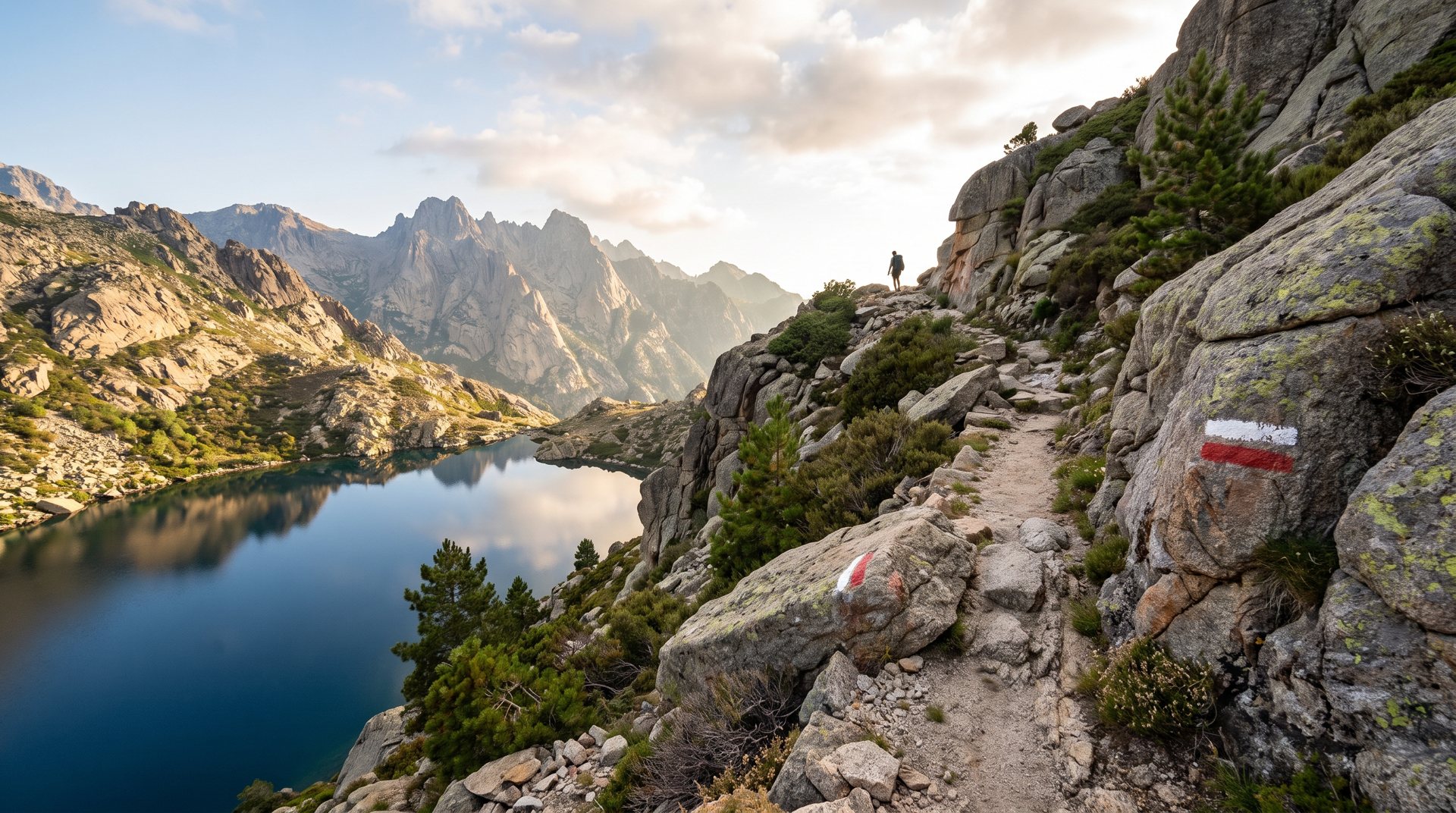
- The GR20 crosses Corsica’s mountains in 16 official stages, from Calenzana in the north to Conca in the south, with Vizzavona marking the split between the northern and southern halves.
- Booking is compulsory for every night in a Park refuge, including bunks, bivouac pitches and tent hire, through the official Parc naturel régional de Corse reservation centre.
- The 2027 booking dates and prices had not been published at the time of writing: plan your stages now, then book as soon as the Park opens its platform.
The GR20 in Corsica is the island’s legendary high-level trail, a demanding mountain route that runs along the granite spine of Corsica from Calenzana, near Calvi, to Conca, north of Porto-Vecchio. If you are dreaming of hiking it in summer 2027, the planning starts long before you pack your boots: refuge places are limited, booking is compulsory and the best dates go quickly. This guide covers the route, refuge booking, the season, access by train and bus, kit and safety. Every practical rule and price below comes from the Parc naturel régional de Corse (PNRC), the body that manages the refuges and the booking system.
GR20 Corsica at a glance: what you are signing up for
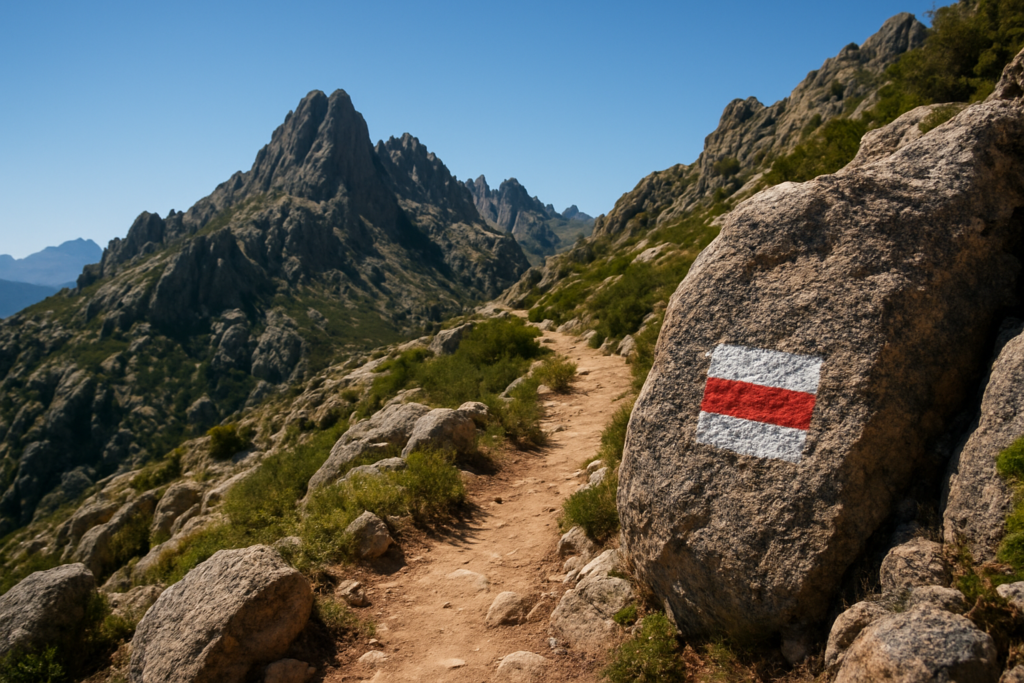
Known in Corsican as Frà li monti (“through the mountains”), the GR20 is described by the Parc naturel régional de Corse as one of the most difficult trails in Europe. The official route is divided into 16 stages, each ending at a refuge or at a village with private accommodation. The trail is waymarked in white and red, and the Park notes that the marks are well maintained and easy to spot.
The route falls naturally into two halves:
- The northern GR20 (stages 1 to 9, Calenzana to Vizzavona): the most mineral and technical part, with rocky slabs, scree, steep passes and a few sections equipped with chains and handrails. The Park describes these stages as very technical and hard on the joints.
- The southern GR20 (stages 10 to 16, Vizzavona to Conca): greener and less technical, with forests, open ridges, the Cuscionu plateau and the Bavella needles, but still a serious mountain walk.
Many walkers split the route over two holidays, and Vizzavona, with its railway station, makes this very easy.
The 16 official stages and walking times
The table below lists the official stages with the one-way walking times published by the Park for the classic north to south direction. These times do not include breaks, photo stops or bad weather, so treat them as a minimum.
| Stage | From / to | Official time (north to south) | Section |
|---|---|---|---|
| 1 | Calenzana to Ortu di u Piobbu | 6h30 | North |
| 2 | Ortu di u Piobbu to Carrozzu | 7h | North |
| 3 | Carrozzu to Ascu Stagnu | 6h10 | North |
| 4 | Ascu Stagnu to Tighjettu | 8h | North |
| 5 | Tighjettu to Ciottulu di i Mori | 4h | North |
| 6 | Ciottulu di i Mori to Manganu | 8h | North |
| 7 | Manganu to Petra Piana | 6h30 | North |
| 8 | Petra Piana to L’Onda | 4h50 | North |
| 9 | L’Onda to Vizzavona | 6h05 | North |
| 10 | Vizzavona to E Capanelle | 5h15 | South |
| 11 | E Capanelle to Prati | 6h10 | South |
| 12 | Prati to Usciolu | 5h45 | South |
| 13 | Usciolu to Cuscionu | 4h25 | South |
| 14 | Cuscionu to Asinao | 4h15 | South |
| 15 | Asinao to Paliri | 7h | South |
| 16 | Paliri to Conca | 5h | South |
Water is the key planning point: the Park warns that there is no water between the spring above Ortu di u Piobbu and Carrozzu, and none on stage 3 (Lake Muvrella is not drinkable). On stage 8, a shorter ridge variant marked in yellow should only be attempted in settled weather.
How to book GR20 refuges for 2027
This is the part that catches most first-timers out. According to the Park, reservations are compulsory for all nights in its refuges, whether you sleep in a bunk inside the hut, pitch your own tent on the bivouac area or hire one of the Park’s tents. Bookings are made online through the official PNRC reservation centre, which has an English version.
When do 2027 bookings open?
At the time of writing (October 2026), the Park had not announced the opening date of the 2027 booking platform, nor the 2027 season dates or prices. For the 2026 season, the refuges were staffed from 16 May to 4 October inclusive. There is no guarantee that 2027 will follow the same calendar, so the safest approach is to have your itinerary ready by the turn of the year and to check the Park’s website and social channels regularly.
How the booking system works
- One booking per person, per night: if you bring your own tent, you must book one bivouac pitch per person. Two people sharing a tent book two pitches.
- Named and date-specific: reservations are nominative and only valid for the refuge and date chosen. If you decide to double up stages on the trail, the Park explains that your booking cannot be moved to another refuge unless it is changed at least 48 hours before the walking day, subject to availability.
- Proof of booking: after payment you receive a confirmation email and an invoice, which you must show to the warden when you arrive.
- Arrival time: reserved places are guaranteed until 7pm. To order dinner, the Park asks walkers to arrive by 6pm at the latest.
- Changes and cancellations: changes should be requested 48 hours before the walking day; cancellations are handled under the general terms of sale, which the Park summarises as two months before the start of your hike. Read them before you pay.
Refuge prices (2026 rates, for reference)
The Park’s 2026 rates give you an idea of the budget, but expect them to be reviewed for 2027:
| Service (PNRC refuges, 2026) | Price |
|---|---|
| Bunk inside the refuge, per person | €20 |
| Bivouac pitch with your own tent, per person | €12 |
| Park tent for 1 person (pitch + tent) | €27 |
| Park tent for 2 people (2 pitches + tent) | €39 |
| Breakfast / packed lunch / evening meal (approximate) | about €10 / €10 / €20 |
The Park suggests budgeting around €50 a day for all meals. Meals, packed lunches and breakfasts are ordered on site only, and payment for them is by cash or cheque, so carry enough euros: there are no cash machines on the trail. All Park tents sleep two and come with a thin mattress, but you must carry your own sleeping bag. Note that Ortu di u Piobbu and Asinao do not offer bunks at all, only bivouac pitches and tent hire.
What you will find in a GR20 refuge
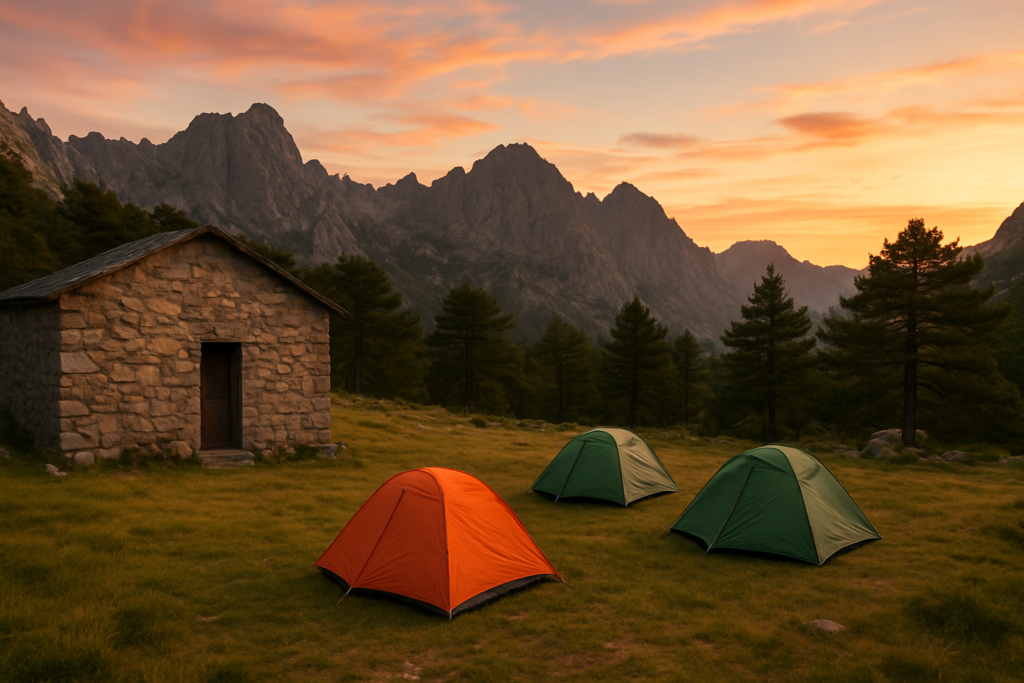
Comfort is basic but functional. According to the Park, each refuge has around thirty beds on average, a bivouac area, an outdoor kitchen with gas, a common room, a meal service, a small shop, showers, dry toilets, running water, an emergency medical kit and tent hire. Phone charging is free except at Ortu di u Piobbu and Asinao.
Between refuges, a few private establishments help: hotels, gîtes and a bivouac area at Vizzavona, a gîte at E Capanelle, and shepherds’ huts and gîtes around the Cuscionu plateau. These are run privately and booked directly with them.
When to hike the GR20
The hiking season follows the refuge opening period, roughly from mid-May to early October based on the 2026 calendar. Each part of the season has its trade-offs:
- Late May and June: long days and greener landscapes, but snow patches can linger high up. On stage 7, the Park warns that early-season snowfields may require crampons, a rope and an ice axe.
- July and August: the busiest and hottest period, when refuges fill fastest. Water becomes scarce on some sections (the Park flags shortages around Usciolu in July and August), and wildfire rules are at their strictest.
- September: quieter, with shorter days and storms still possible.
Remember that summer is also peak season for flights and ferries, so book your travel early once your refuges are confirmed. Before and during the hike, check the official mountain forecast from Météo-France for the Corsican mountains, as the Park recommends: violent storms can build quickly, even in summer.
Getting to the start, the finish and Vizzavona
A car is of little use on a linear trail, so most walkers rely on public transport:
- Calenzana (start): the village sits inland from Calvi. Calvi is the end of the Balagne line of the Chemins de fer de la Corse, and from there you continue to Calenzana by road. Check bus or shuttle options before you travel, as services are seasonal.
- Vizzavona (halfway): the village has a station on the Ajaccio to Bastia line, which is why so many walkers finish or start here. The Park itself suggests leaving by train towards Ajaccio or Bastia if you only walk the northern half.
- Conca (finish): the Park mentions a shuttle on request from Conca to Santa Lucia di Porto-Vecchio and Porto-Vecchio, from where you can continue by bus.
Timetables change with the seasons, so always check the current CFC train timetables and the bus operators before booking flights or ferries. Our practical guides to the Corsica train and to buses in Corsica explain how the network works and how to combine it with your arrival port or airport.
Equipment: the Park’s compulsory kit list
The Park publishes a list of essential items it considers compulsory for the GR20:
- a sleeping bag;
- a waterproof jacket (Gore-Tex type or equivalent);
- a warm layer (fleece or down jacket);
- trousers and shorts;
- a first aid kit and a survival blanket;
- a shower towel;
- mountain boots;
- a cap;
- a head torch;
- a filter bottle and water purification tablets;
- the official FFRandonnée TopoGuide “À travers la Montagne Corse” (ref. 067).
Keep your pack light. Note that the Park bans their use at Lake Ninu and on the Cuscionu plateau, to protect the fragile wetlands known as pozzines.
Safety and rules on the trail
The Park and the rescue services insist on a few rules: tell someone your itinerary, stay on the marked path, avoid walking alone, watch the weather and be ready to turn back. If in doubt, hire a mountain guide.
In an emergency, call 112 (European emergency number), 17 (gendarmerie) or 18 (fire service). Mobile coverage is unreliable along the whole route, and the Park lists several refuges where calls may be impossible, including Ortu di u Piobbu, Carrozzu, Tighjettu, Ciottulu di i Mori, Manganu, L’Onda, Usciolu and Paliri. Dogs must be kept on a lead (and are strongly discouraged), and swimming in high-altitude lakes is forbidden.
GR20 quiz
Pick an answer and the correction appears instantly.
1. How many official stages does the GR20 have?
Correct: the Park lists 16 stages from Calenzana to Conca.Not quite: the official route has 16 stages.
2. Which village marks the split between the northern and southern GR20?
Right: Vizzavona ends stage 9 and has a railway station.No: the halfway point is Vizzavona, on the Ajaccio to Bastia line.
3. Is booking compulsory for a bivouac pitch with your own tent?
Exactly: the Park requires one booked pitch per person.Not quite: booking is compulsory, one pitch per person.
4. What is the latest time you can set off on the GR20 from Calenzana?
Correct: a municipal order bans departures after 11am.No: no departure from Calenzana is allowed after 11am.
FAQ
How many stages does the GR20 have?
The official route managed by the Parc naturel régional de Corse has 16 stages, from Calenzana to Conca, with Vizzavona at the end of stage 9 separating the northern and southern halves.
Do I need to book GR20 refuges in advance?
Yes. The Park states that reservations are compulsory for all nights in its refuges, including bunks, bivouac pitches with your own tent and tent hire. You book online through the official PNRC reservation centre.
When do GR20 reservations open for 2027?
The 2027 opening date had not been published at the time of writing. Check the Park’s website and social channels from the end of 2026 onwards.
Can I wild camp on the GR20?
No. Wild bivouacs are banned under municipal orders. Camping is only permitted near the refuges or on designated areas, and you must book a pitch.
How do I get to Vizzavona to start or finish halfway?
Vizzavona has a station on the Chemins de fer de la Corse line between Ajaccio and Bastia, so you can arrive or leave by train. Check the current timetable before you travel.