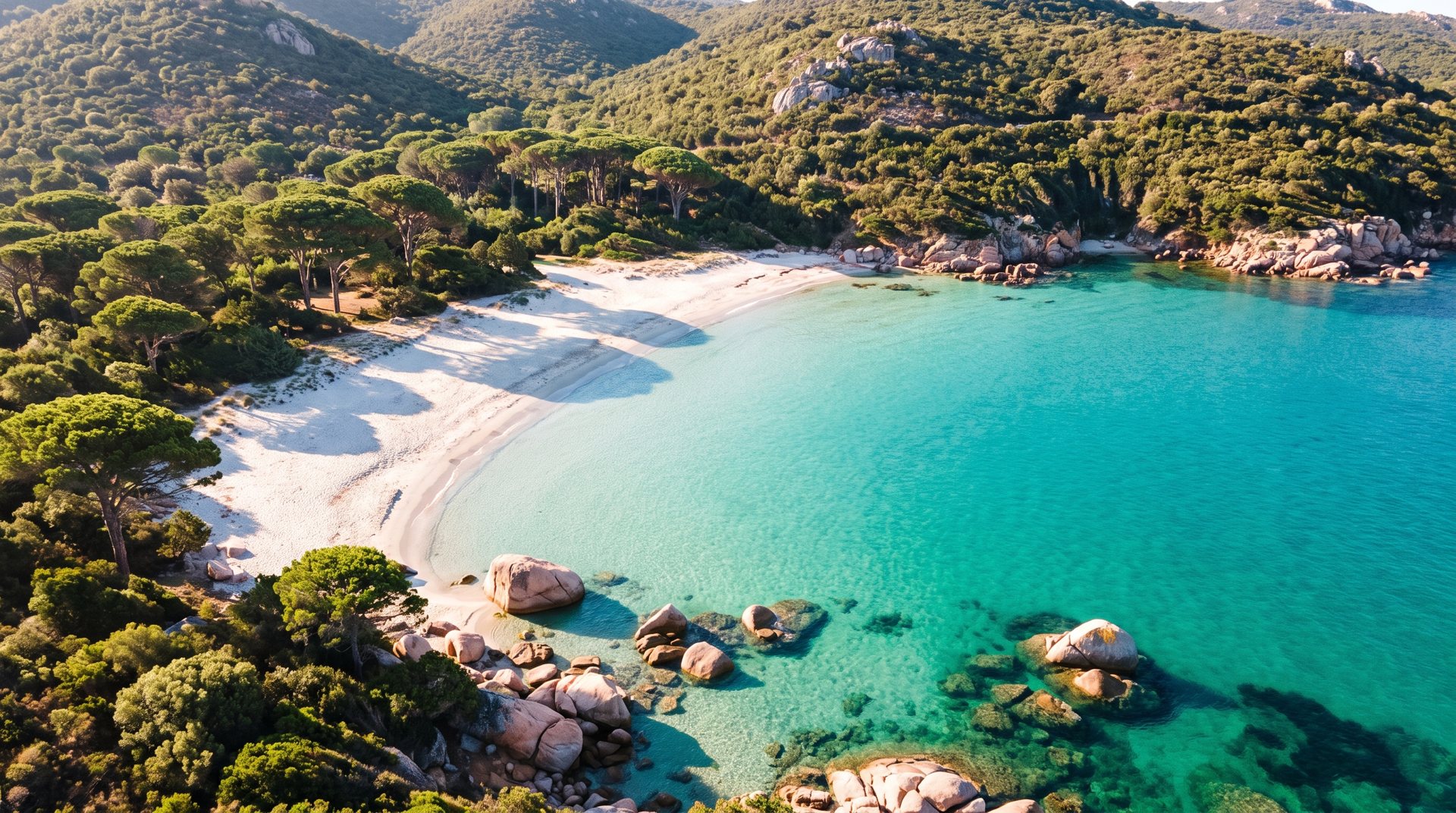
- The best beaches in Corsica are spread right round the island: lagoon-like bays in the south, surf and red granite on the west coast, long sandy strands in the Balagne, and wild, roadless coves in the Désert des Agriates.
- Our 15 picks run from easy, family-friendly beaches with car parks and restaurants (Santa Giulia, Calvi) to places you reach only on foot, by boat or by 4×4 track (Saleccia, Lotu, Petit Sperone).
- Many of these beaches sit inside protected areas (nature reserve, Natura 2000 or Conservatoire du littoral land), so expect rules on dogs, fires, camping, smoking and anchoring, and paid parking at the busiest bays in summer.
Choosing the best beaches in Corsica is a pleasant problem: the island has hundreds of bays and coves, and the “right” one depends on whether you want shallow water for children, waves for surfing, or a long walk to a beach with no road at all. This guide picks 15 bays worth the drive, grouped by region so you can plan them around where you stay. For each one we explain how you get there, who it suits and what to watch out for. The descriptions rely on the official tourist offices of Bonifacio, Calvi-Balagne, Ajaccio and Saint-Florent, on Visit Corsica (the Corsican tourism agency’s website) and on the Conservatoire du littoral, the public body that owns and protects much of the wild coastline.
If you are still deciding where to base yourself, our guide to villas near the beach in Corsica covers accommodation close to the sand. This article focuses on the beaches themselves.
The best beaches in Corsica at a glance
The table below sums up the 15 beaches. “Easy” access means you can park close by and walk a few minutes; “walk” or “boat” means you need to plan ahead with water, shoes and time.
| Beach | Region | Access | Ideal for |
|---|---|---|---|
| Rondinara | South (Bonifacio) | Easy, paid car park | Families, calm water |
| Santa Giulia | South (Porto-Vecchio) | Easy | Families, water sports |
| Palombaggia | South (Porto-Vecchio) | Easy | Classic postcard views |
| Petit and Grand Sperone | South (Bonifacio) | Short path | Clear water, photographers |
| Roccapina | South-west (Sartenais) | Track and path | Scenery, quieter days |
| Capo di Feno | West (Ajaccio) | Road, or walk to Petit Capo | Surfers, wild feel |
| Arone | West (Gulf of Porto) | Road | Turquoise water, views |
| Calvi | North (Balagne) | Easy, train | Town beach, all ages |
| Bodri | North (Balagne) | Paid car park or train | Swimming, windsports |
| Ostriconi | North (Balagne / Agriates) | Walk of about 15 minutes | Dunes, unspoilt nature |
| Saleccia | Désert des Agriates | Boat, 4×4 track or long walk | Adventure, white sand |
| Lotu | Désert des Agriates | Boat or long walk | Day trip from Saint-Florent |
| Nonza | Cap Corse | On foot from the village | Unusual landscape |
| Fautea and Lavu Santu | East coast | Roadside parking, path | Snorkelling, walkers |
| Pinarellu | East coast | Easy | Village atmosphere |
Southern Corsica: lagoon colours around Bonifacio and Porto-Vecchio
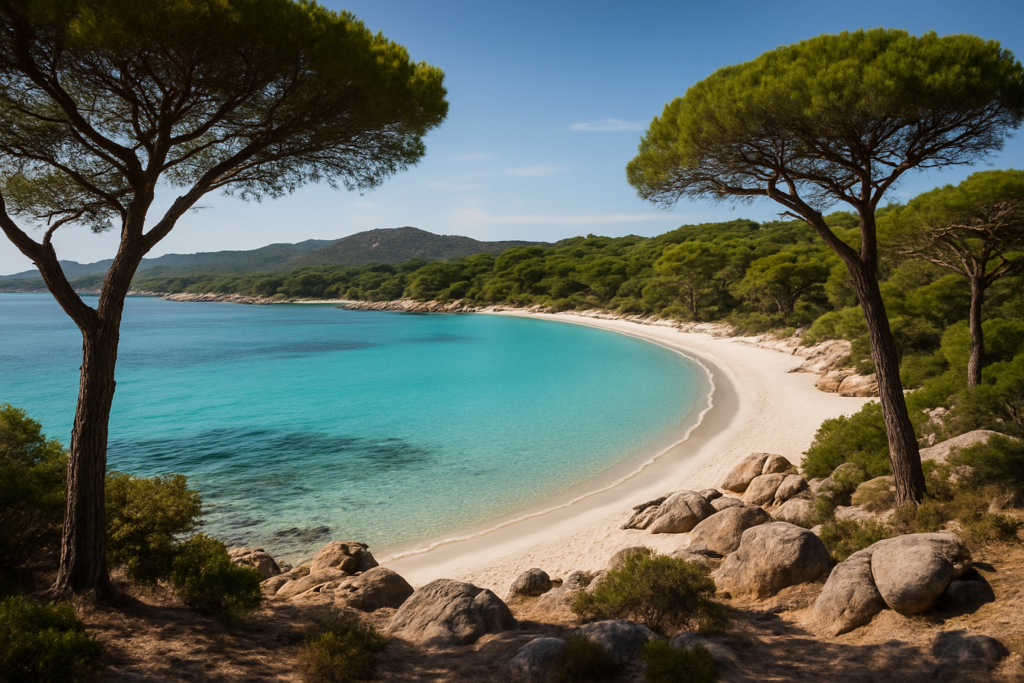
The far south is where most of the famous photographs are taken. The Bonifacio Tourist Office describes a coastline of fine white sand, pine forests and coves, much of it bordering the Bouches de Bonifacio nature reserve. It is also the busiest area in July and August, so timing matters. If you plan to tour several of these bays, our guide to driving in Corsica explains what to expect on the roads.
1. Rondinara
Halfway between Bonifacio and Porto-Vecchio, Rondinara is a rounded, shell-shaped bay of fine sand and very gently sloping water, which is why the tourist office recommends it for children. The bay faces the Bouches de Bonifacio nature reserve and has kept its wild setting, even though there is a beach restaurant. The official listing notes a paying car park, a Natura 2000 classification and a “plage sans tabac” (smoke-free beach) label. Cows sometimes wander onto the sand: leave them alone. The tourist office’s own tip is to arrive in the morning, when it is quieter.
2. Santa Giulia
Santa Giulia, south of Porto-Vecchio, is the beach of advertising campaigns: turquoise, shallow water in a cove the tourist office puts at two kilometres long, a pontoon that has become a favourite photo spot, beach restaurants and plenty of water sports. Behind the beach lies a pond where pink flamingos can be seen in winter. It is one of the easiest beaches in Corsica for families with young children.
3. Palombaggia
Palombaggia is Porto-Vecchio’s best-known beach: fine sand lined with pine trees, gradations of blue and a view of the Cerbicale islands, with a string of coves along the coast. Its first cove, I Pini, has pink granite rocks and a pine forest protected by the Conservatoire du littoral, and the tourist office notes it is accessible to people with reduced mobility. We will cover Palombaggia in more depth in a dedicated guide; for now, simply know that it fills up quickly in high summer.
4. Petit and Grand Sperone
Near the southern tip of the island, the two Sperone beaches are known for ultra-fine sand and crystal-clear water. Petit Sperone is a small white cove among the rocks, facing the island of Piana, which you only discover at the very end of the path. Both beaches are part of the Bouches de Bonifacio nature reserve and, according to the tourist office, are free of seagrass. Two warnings: they are busy in July and August, and the fine sand blows everywhere when the wind comes from the east. Bins are only provided at Grand Sperone, so be ready to take your rubbish away.
5. Roccapina
Between Sartène and Bonifacio, Roccapina is a wide bay watched over by a Genoese tower and by the famous Lion of Roccapina, a pink granite rock shaped by water and wind. Visit Corsica describes the view from the tower as one of the most iconic landscapes in southern Corsica. The beach feels far more natural than the Porto-Vecchio bays, which makes it a good choice for a quieter day, but the access is not as straightforward, so allow time.
West coast: surf, red rock and the Gulf of Porto
The west coast is rockier and more exposed than the south. Beaches here are often framed by granite headlands, the sunsets are spectacular, and the sea can be rougher.
6. Capo di Feno
Just outside Ajaccio, Capo di Feno is in fact two white sandy beaches, Grand Capo and Petit Capo, separated by a field, halfway between the Gulf of Ajaccio and the Gulf of Sagone. The Ajaccio Tourist Office calls it one of the best-known surf spots in Corse-du-Sud and warns that waves can be strong, so watch the sea and the swimming flag. In summer the beaches are supervised: the tourist office lists lifeguards from 1 July to 31 August, from 12:00 to 19:00. Petit Capo can also be reached on foot from the Parata peninsula, a walk of about an hour with little shade.
7. Arone
Near the Gulf of Porto and the Scandola reserve, Arone is a beach of fine sand and clear turquoise water, with a sweeping view of Capo Rosso, according to Visit Corsica. It combines well with a visit to the Calanques de Piana and the villages of the Gulf of Porto, and the drive itself is part of the experience.
The Balagne: long sandy beaches between Calvi and L’Île-Rousse
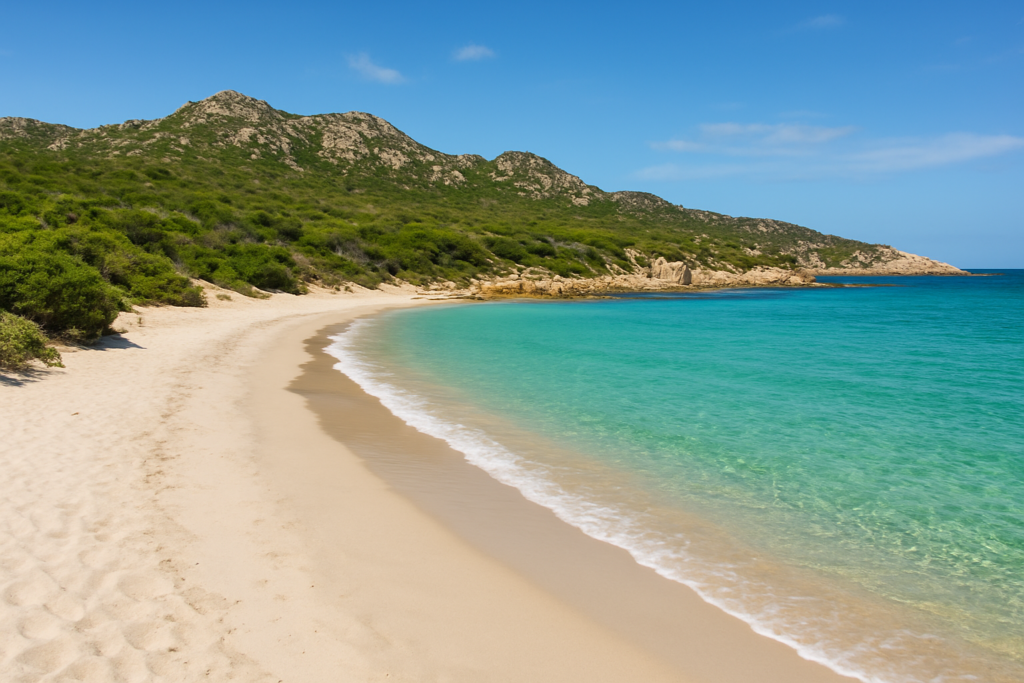
In the north-west, the Balagne has some of the island’s longest sandy beaches and one big advantage: you can reach several of them by train. The tourist office explains that the little Balagne line runs along the coast between Calvi and L’Île-Rousse as a shuttle that stops in front of each beach, with open windows in summer.
8. Calvi
Calvi’s town beach stretches for nearly four kilometres of fine white sand, according to the Calvi-Balagne Tourist Office, with views of the mountains and of the citadel. It is the easiest beach on this list: shops, restaurants and the station are close by, and it suits all ages.
9. Bodri
Bodri and its neighbour Ghjunchitu sit below the road between L’Île-Rousse and Calvi. The tourist office places them about 2 km from the edge of L’Île-Rousse, with a signposted entrance and a paying car park for the day; the Balagne train also stops at Bodri station, from where a path leads down to the sand. Bodri is supervised in summer within a marked zone and, when the wind blows, attracts kitesurfers and windsurfers. Note that animals are banned on these beaches, even on a lead.
10. Ostriconi
At the mouth of the river of the same name, on the edge of the Agriates, the Calvi-Balagne Tourist Office describes Ostriconi as 800 metres of fine sand and white dunes in a landscape with no urbanisation. It lies about 15 km from L’Île-Rousse towards Bastia: park near the campsite and allow about 15 minutes on foot, with proper shoes, and be ready to wade across the river. The beach is supervised in summer and dogs on a lead are accepted. It is also the western start of the coastal path to Saint-Florent.
Désert des Agriates and Cap Corse: the wild north
Between the Balagne and Saint-Florent, the Agriates is a vast area of maquis with no road along the coast. According to the Conservatoire du littoral, it includes 37 km of natural shoreline with no urbanisation at all, much of it acquired by the Conservatoire since 1979, and it belongs to the European Natura 2000 network. Its main beaches are Saleccia and Lotu in the east, and Ghignu and Ostriconi in the west.
11. Saleccia
Saleccia is often named the most beautiful beach in Corsica, and the effort to reach it is part of its appeal. The Saint-Florent Tourist Office lists three ways in: on foot along the coastal path, by boat, or by a 4×4 track from Casta, one of only two tracks open to motor vehicles. The Conservatoire notes that the Aleppo pines on the dunes were planted in the 19th century, and that during the Second World War the submarine Casabianca landed weapons for the Resistance on this beach. Drinking water is only available at Saleccia (at the campsite or the beach café).
12. Lotu
Lotu is the closest Agriates beach to Saint-Florent and the usual choice for a day trip by boat. Walkers can follow the coastal path: the tourist office counts 4 h 45 from Saint-Florent to Lotu, then 1 h more to Saleccia. Combining the boat out and a walk between the two beaches is a classic way to see both in one day.
13. Nonza
On the west side of Cap Corse, below the hilltop village of Nonza and its tower, lies one of the island’s strangest beaches: a long stretch of dark grey pebbles, whose colour comes from the waste of a former asbestos quarry further up the coast at Canari. You reach it on foot from the village. It is not a sunbathing beach in the usual sense, but the contrast between the dark shore, the blue sea and the village above makes it unforgettable.
East coast: towers, coves and fishing villages
The east coast north of Porto-Vecchio is gentler, with long beaches and small coves around Sainte-Lucie de Porto-Vecchio.
14. Fautea and Lavu Santu
According to Visit Corsica, the Fautea Tower, some thirty metres high, overlooks two beaches. The northern one is lively, with a restaurant, a campsite, water sports and a beach lift for people with reduced mobility. The southern one is wilder and marks the start of the customs path to Lavu Santu, a 900-metre stretch of sand reached in about 30 minutes on foot. The beaches are good for snorkelling, but Lavu Santu shelves steeply and is not recommended for children. The site has been protected by the Conservatoire du littoral since 1979. Park at the roadside on the RT10 when the tower comes into view.
15. Pinarellu
Pinarellu, also in Sainte-Lucie de Porto-Vecchio, has a Genoese tower and maquis on one side, a pine forest along the shore on the other, and fishing boats in the bay. The Bonifacio Tourist Office describes it as very busy yet still full of character, with fine white sand and turquoise water. Nearby Saint-Cyprien, with its shallow water, is another good option for young children.
Practical tips: rules, parking and timing
A few points apply to almost every beach on this list:
- Protected areas: many beaches lie in the Bouches de Bonifacio nature reserve, in Natura 2000 sites or on Conservatoire du littoral land. Rules vary, so read the signs on arrival.
- Anchoring: if you arrive by boat, never drop anchor on Posidonia seagrass meadows. Anchoring along the French Mediterranean coast is regulated by the Préfecture maritime de la Méditerranée, and protected zones may have their own restrictions.
- Parking: popular beaches such as Rondinara and Bodri have paid car parks in season. Prices change, so take some cash and a card.
- Dogs: rules differ from beach to beach: banned at Bodri, accepted on a lead at Ostriconi.
- Timing: the tourist offices repeatedly advise arriving early. Mornings are calmer, cooler and easier for parking. Spring and early autumn are much quieter than July and August; our guide to the best time to visit Corsica explains the seasons in more detail.
Corsica beaches quiz
Pick an answer and the correction appears instantly.
1. Which Corsican region has beaches you can reach on the little coastal train?
Correct: the Balagne line stops in front of several beaches.Not quite: it is the Balagne, between Calvi and L’Île-Rousse.
2. How can you reach Saleccia beach?
Right: coastal path, boat or the 4×4 track from Casta.No: Saleccia is reached on foot, by boat or by 4×4 track.
3. Why is Nonza beach dark grey?
Exactly: the pebbles come from the old Canari quarry.Not quite: the colour comes from the former asbestos quarry at Canari.
4. Which beach near Ajaccio is known as a surf spot?
Correct: Capo di Feno is a well-known surf spot.No: the surf spot near Ajaccio is Capo di Feno.
FAQ
Which is the most beautiful beach in Corsica?
There is no official ranking. Saleccia, Rondinara, Santa Giulia and Palombaggia appear on almost every list, but the best choice depends on what you want: easy access and shallow water, or a long walk to a wild beach.
Which side of Corsica has the best beaches?
The south and south-east (Bonifacio, Porto-Vecchio) have the most lagoon-like water and white sand. The north-west Balagne has long sandy beaches reachable by train, and the Agriates has the wildest coastline. The west coast is more rugged, with surf at Capo di Feno.
Can you reach Saleccia beach by car?
Only by 4×4 on the track from Casta, according to the Saint-Florent Tourist Office. Otherwise you can take a boat from Saint-Florent or walk the coastal path, which takes several hours.
Are Corsican beaches good for children?
Yes, many are. Rondinara and Santa Giulia have shallow, gently sloping water, and Calvi has all the facilities of a town beach. Avoid Lavu Santu with young children because it shelves steeply, and watch the flags at surf beaches such as Capo di Feno.
Do you have to pay to park at Corsican beaches?
At some of the busiest ones, yes. Rondinara and Bodri, for example, have paying car parks in season. Fees vary, so check on site.
Which Corsican beaches can you reach by train?
In the Balagne, the coastal train between Calvi and L’Île-Rousse stops in front of several beaches, including Bodri, which makes it easy to enjoy them without a car.