
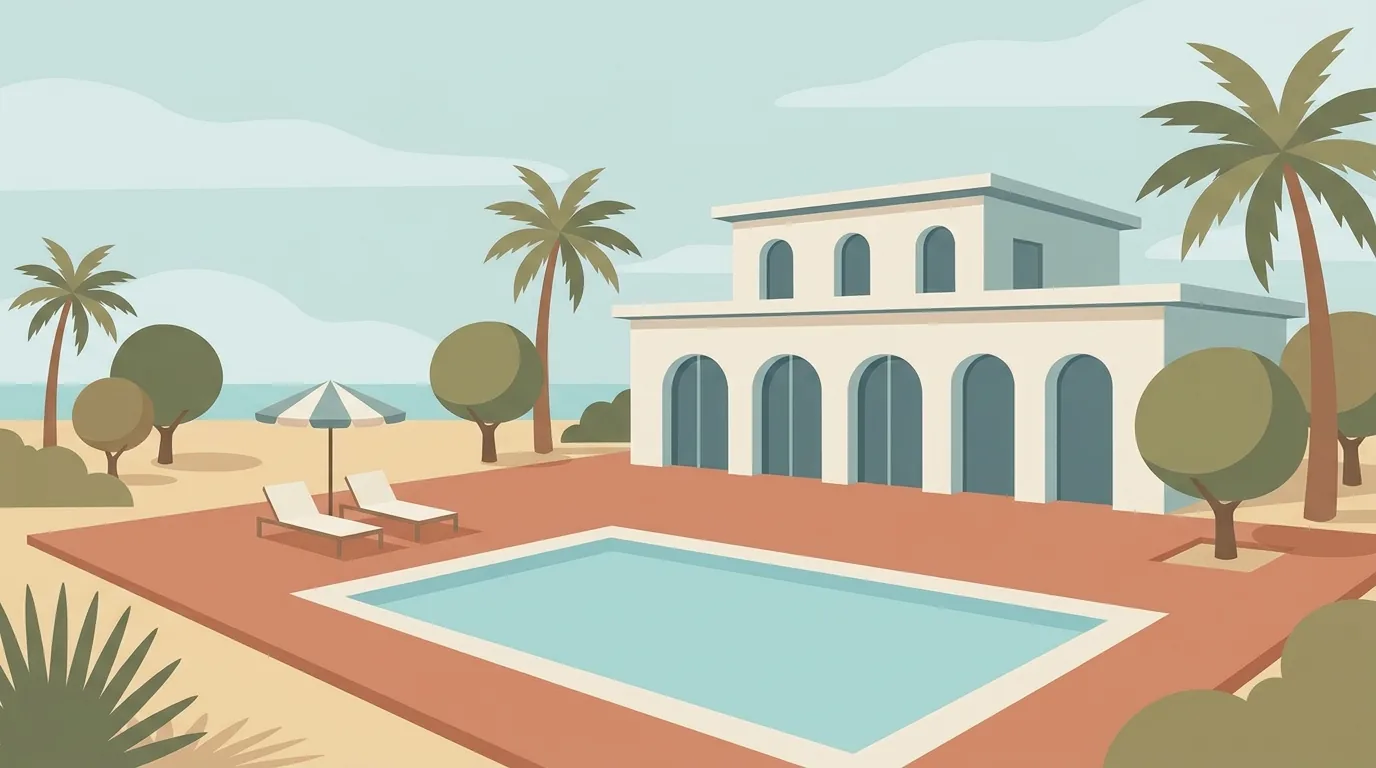
Corsica villas give UK travellers something a hotel room simply cannot: space, privacy and a proper kitchen, all set against mountains that drop straight into the Mediterranean. For families, groups of friends or couples wanting a base rather than a bedroom, a villa turns a week on the island into a self-catered, unhurried holiday rather than a series of restaurant bookings and thin walls.
Why choose a villa in Corsica over a hotel
Corsica is not a package-holiday island in the way parts of mainland Spain or Portugal are, and its hotel stock reflects that: plenty of small, characterful properties, but relatively few large resorts, and prices that climb sharply in July and August. A self-catering villa spreads the cost across several people, gives you a private pool in many cases, and means you are not tied to hotel breakfast times or a single restaurant menu night after night.
The other advantage is flexibility. Corsica’s produce, from Corsican charcuterie and cheese to tomatoes and figs sold at village markets, is genuinely worth cooking with, and a villa kitchen lets you do that. It also suits the island’s driving-heavy holiday pattern: you can head out early for a beach or a hike, come back for a long lunch by the pool, and go out again in the cooler evening, without checking in and out of a hotel room in between.
- More space per person, particularly useful with children or multi-generational groups
- A private or shared pool, common even on modest budgets outside peak season
- Freedom to cook with local ingredients rather than eating out every meal
- Often better value than several hotel rooms for a group of six or more
CORSICA VILLAS AT A GLANCE
Choosing your region
Corsica is small on a map but slow to cross, so where your villa sits matters more than it might elsewhere. Deciding on a region before you start browsing listings will save a lot of time.
Balagne and Calvi (north west)
The Balagne, around Calvi and L’Île-Rousse, has some of Corsica’s best sandy beaches, a lively marina town in Calvi itself, and a network of hilltop villages (Pigna, Sant’Antonino, Corbara) that make for good day trips. It is a strong choice for families wanting beach time plus some culture, and Calvi Airport puts it within easy reach on arrival.
The Extreme South: Porto-Vecchio and Bonifacio
This is Corsica’s glamour corner. Porto-Vecchio has the white sand beaches (Palombaggia, Santa Giulia) that fill Instagram feeds, plus a busy nightlife scene in season, while Bonifacio, perched on limestone cliffs above the sea, is one of the most photographed towns in the Mediterranean. Villas here tend to command a premium, especially anything with sea views, and this region books up earliest for August.
Ajaccio and the west coast
Ajaccio, Napoleon’s birthplace, is Corsica’s capital and gives you a genuine working town alongside good beaches nearby (Îles Sanguinaires, Porticcio across the gulf). It is a sensible base for travellers who want some city amenities, direct flights, and a shorter transfer than the far south, while still having the rugged west coast scenery on the doorstep.
Cap Corse
The narrow peninsula north of Bastia, Cap Corse, is quieter and more rural, with fishing villages, vineyards and a dramatic coast road. It suits travellers who have done the main sights before and want somewhere less crowded, though facilities and restaurant choice are thinner outside the main villages.
The interior
Inland Corsica, around villages such as Corte, Sartène or the Aiguilles de Bavella, is mountainous, forested and noticeably cooler in summer. Villas here suit hikers and those chasing a rural, authentic Corsica rather than a beach base; you will need a car for everything, including reaching the coast for a swim.

Types of villa and what to expect
“Villa” covers a wide range of properties on Corsica, from a simple two-bedroom stone house with a plunge pool to a sprawling six-bedroom estate with sea views and a housekeeper included. Knowing the typical categories helps you filter listings realistically.
- Village or town-edge villas: often converted stone houses on the edge of a Balagne or interior village, walking distance to shops and restaurants, usually with a smaller pool
- Countryside villas (mas or maison): set among vineyards, olive groves or maquis scrubland, more privacy, a larger garden, but a car is essential
- Sea-view or coastal villas: the most sought-after category around Porto-Vecchio, Bonifacio and the west coast, commanding the highest prices, particularly with direct beach access
- Modern architect-built villas: more common near Porto-Vecchio and Ajaccio, typically with air conditioning, a larger infinity-style pool and full outdoor kitchens
Most Corsica villas rent by the week in peak season (June to September) and can be more flexible with shorter stays in spring and autumn. Air conditioning is worth checking specifically: it is standard in newer builds but still absent from some older stone properties, which can be uncomfortable in a July heatwave despite thick walls keeping them cooler than you might expect.
Corsica villas: a price guide by season and region
Prices below are indicative weekly rates for a typical three-to-four-bedroom villa with a private pool, in euros, and vary considerably by exact location, sea view and standard of finish. Treat them as a rough planning guide rather than a quote.
| Region | Low season (Apr-May, Oct) | Mid season (Jun, Sep) | Peak season (Jul-Aug) |
|---|---|---|---|
| Balagne / Calvi | from around €900 | around €1,600-2,200 | typically €2,800-4,000+ |
| Porto-Vecchio / Bonifacio | from around €1,100 | around €2,000-2,800 | typically €3,500-6,000+ |
| Ajaccio / west coast | from around €800 | around €1,400-2,000 | typically €2,500-3,800 |
| Cap Corse | from around €700 | around €1,200-1,700 | typically €2,000-3,000 |
| Interior (Corte, Sartène area) | from around €600 | around €1,000-1,500 | typically €1,800-2,600 |
The gap between low and peak season is dramatic almost everywhere, but it is most extreme in the Extreme South, where demand for August is highest. Booking for June or the second half of September can often halve the cost of the same villa in August while still giving you reliably warm, swimmable weather.
Booking a Corsica villa: timing and what to check
Corsica has a genuinely short high season, and the best villas, particularly anything with sea views or a private pool near Porto-Vecchio, Bonifacio or Calvi, are often reserved six to nine months ahead for August. If your dates are fixed to the school summer holidays, start looking in the preceding autumn or winter rather than waiting until spring.
When to book
- Peak weeks (mid-July to end August): book 6-9 months ahead for the best choice
- Shoulder season (June, September): 3-4 months ahead is usually comfortable
- Low season (April, May, October): often bookable a matter of weeks out, with more room to negotiate
What to check before you commit
Villa contracts and listing standards vary more between owners than they do with hotel chains, so a few practical checks before booking will save disappointment on arrival.
- Deposit and cancellation terms: a security deposit (caution) of a few hundred euros is standard, refundable after checkout inspection; confirm how and when it is returned
- Cleaning fee: often charged separately from the rental price and not always shown prominently in the headline rate, so check the total cost before comparing villas
- Distance to the beach: “sea view” and “beachfront” are used loosely; ask for the actual distance in metres or driving minutes, since many attractive Corsica villas are on hillsides several minutes’ drive from the nearest sand
- Travel insurance excess: check what your policy covers for cancellation, and whether a villa’s own cancellation policy leaves a gap you might need to insure separately
- Pool safety and fencing: relevant for families with young children, as private pools are rarely fenced in the way public ones are
- Air conditioning and Wi-Fi: confirm both explicitly rather than assuming, especially in older stone properties in the interior or Cap Corse
Practical tip: ask the owner or agency for the total price including cleaning fee, tourist tax and deposit before comparing two villas, since the headline weekly rate alone can be misleading and make a cheaper-looking property end up costing more overall.
Getting there and getting around
Corsica has four main airports, at Bastia, Ajaccio, Calvi and Figari (serving Porto-Vecchio and Bonifacio), plus ferry ports at Bastia, Ajaccio, Propriano and Île-Rousse with connections from mainland France and Italy. Choosing a villa near the airport or port you are flying or sailing into makes a real difference: the coast road network is scenic but slow, and a transfer from Bastia to a villa near Bonifacio, for example, can easily take three hours.
Once on the island, a hire car is close to essential for a villa stay. Public transport exists but is thin outside the main towns, and most villas, even those close to a village, are not realistically reachable on foot with luggage or beach gear. Book a car alongside your villa rather than leaving it until arrival, since availability tightens in peak season just as accommodation does.
Practical routes to know
- Calvi or L’Île-Rousse airport/port for Balagne villas
- Figari airport for Porto-Vecchio and Bonifacio villas (roughly 25-45 minutes by car)
- Ajaccio airport or port for west coast villas
- Bastia airport or port for Cap Corse and interior villas
Read also: Corsica ferry deals · Car hire in Corsica
Quiz: Villas in Corsica
Three quick questions to test what you have learned.
1. Which region is best known for upmarket villas and yacht-set glamour?
Porto-Vecchio and its bay are the heart of Corsica’s high-end villa market.Porto-Vecchio is the region most associated with premium villas, not this one.
2. When does the Corsica villa season generally peak?
Peak season runs through summer, when prices and demand are highest.Winter is largely off-season for villa stays in Corsica.
3. What do most standalone Corsica villas offer that hotels typically do not?
Most Corsica villas come with their own pool and enclosed garden for privacy.Think about what sets a private villa apart from a hotel room.
Frequently asked questions
What is the best month to book a villa in Corsica?
June and the second half of September typically offer the best balance of warm, swimmable weather and lower prices, since both sit just outside the school holiday peak. July and August are hottest and busiest, with the Extreme South booking up earliest.
Do Corsica villas usually come with a pool?
Many do, particularly in the mid-range and above, but it is not universal, so always check whether the pool is private or shared, and whether it is heated, since unheated pools can feel cool in early or late season.
Is it better to stay near Porto-Vecchio or Calvi?
Porto-Vecchio and Bonifacio suit travellers prioritising the island’s most famous white sand beaches and a lively summer atmosphere, while Calvi and the Balagne offer excellent beaches with a slightly calmer pace and easier access to hilltop villages. Neither is objectively better; it depends on whether nightlife or a quieter base matters more to you.
Do I need a car if I rent a villa in Corsica?
Yes, in almost all cases. Public transport is limited outside the main towns, and most villas, even those close to a village centre, are set up on the assumption guests have their own vehicle for beaches, restaurants and day trips.
How much deposit do Corsica villa rentals usually ask for?
A refundable security deposit of a few hundred euros is typical, separate from the rental price and any cleaning fee, and is normally returned within a week or two of checkout once the property has been inspected. Terms vary by owner or agency, so confirm the exact figure and refund process before booking.